

There is a version of a Tanzania safari that you will find advertised in many places: a minibus with reclining seats, a rotation of drivers, a shared camp where tables are pre-assigned, and an itinerary that optimises for the average preference of sixteen people who have never met each other. This version of the safari is real. It exists. It is responsible for the vast majority of visitors to Tanzania's national parks.
It is also, in the judgment of everyone who has experienced both, categorically inferior to the alternative. Not marginally worse. Not slightly less enjoyable. A fundamentally different experience — one that leaves you with photographs and memories, and another that leaves you transformed.
“A safari is not a transfer between wildlife sightings. It is a relationship with a landscape. You cannot have that relationship in a convoy.”

On a private safari, the guide's entire attention is on you — when to stop, where to position, how long to linger
The Case Against Group Safaris
The problems with group safaris begin before you leave home. The itinerary is designed to appeal to the widest possible audience, which means it is designed to appeal to no one in particular. The pace is determined by the slowest member of the group and the schedule of the largest camp. The wildlife sightings are shared — not just with your fellow passengers, but with every other group in the park that morning, converging on the same leopard sighting because the guide heard it on the radio like everyone else.
Guide assignment is perhaps the most underappreciated problem. On a group safari, you are assigned a guide from a roster, often the morning of departure. This guide may be excellent. He may also be in his first year, or having a difficult season, or simply not suited to your particular style of travelling. You have no say. The relationship that should develop between guest and guide — which is one of the genuine riches of a Tanzania safari — is replaced by a transactional service arrangement with a stranger.
Pace is another casualty. In a group of sixteen, someone always needs the toilet at the wrong moment, someone has forgotten their binoculars, someone wants to revisit the gift shop. The game drive that should end at the perfect moment for sunset becomes an exercise in logistics management. The sightings that warrant an extra hour are ended on schedule because the camp expects everyone for dinner.
Itinerary rigidity means that if the wildlife is extraordinary at a particular location, you move on anyway because the schedule says so. And if a region is quiet, you spend time there anyway because the bus has to go somewhere. The Serengeti does not organise itself around the convenience of a group schedule. The best safaris are designed around the reality of the wildlife at the moment you are there.
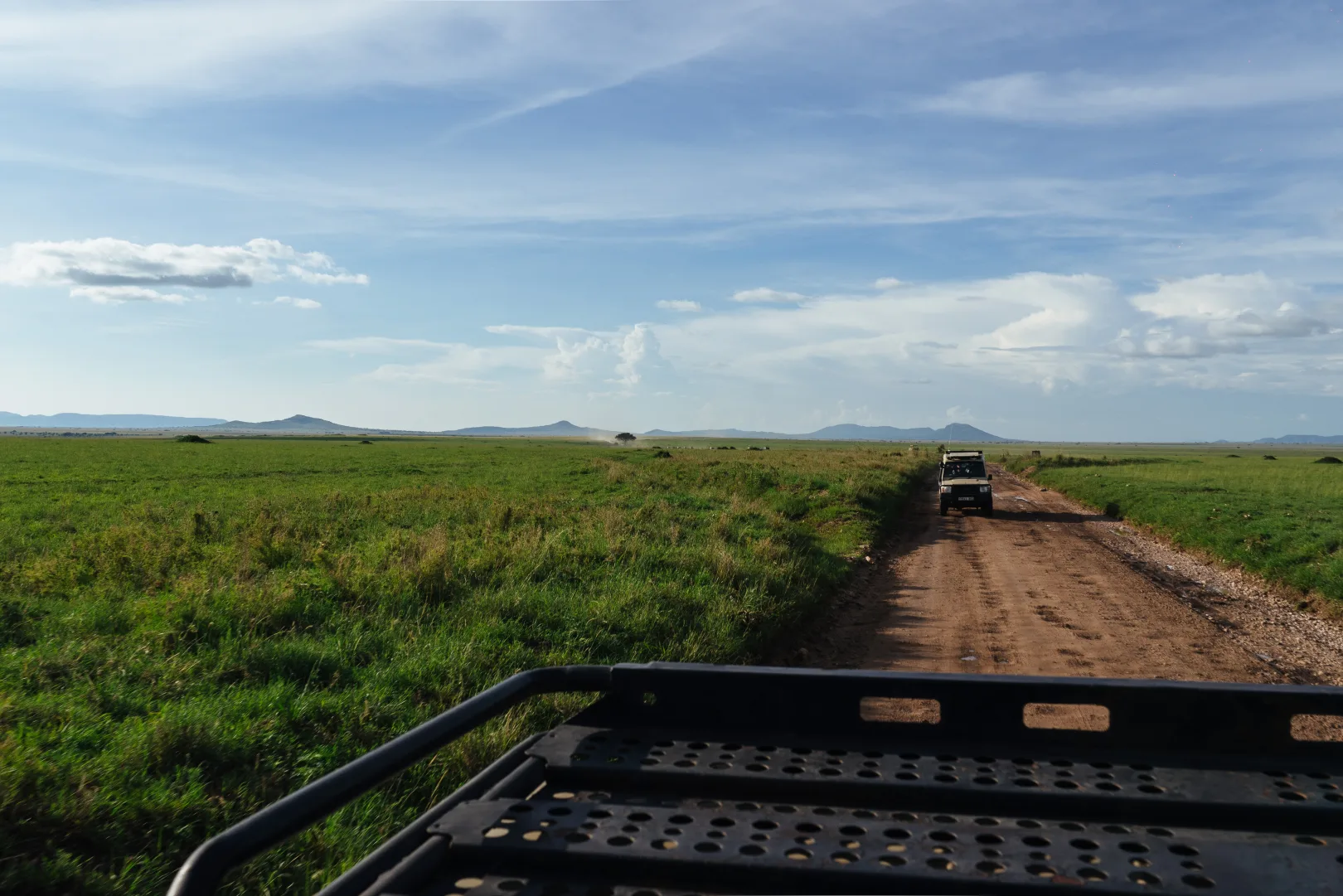
First light on the Serengeti — a private vehicle can be in position before the park roads fill
What a Private Safari Actually Means
A private safari with Bobby means that from the moment you make first contact, you are working with a specific guide — the guide who will actually be with you in the field. The planning conversation is had with Don Kassim or a senior member of the Bobby team, and what emerges from that conversation is an itinerary that is genuinely yours: built around what you want to see, how you want to travel, what pace suits you, and what kind of experience you are hoping to come away with.
Your own guide means someone who has been doing this long enough to read a guest — to know when someone needs to talk and when they need silence, when to explain the microscopic details of dung beetle behaviour and when to simply let the Serengeti speak for itself. Our senior guides have decades in the bush. They are not drivers with wildlife knowledge. They are naturalists who happen to be exceptional drivers.
Your own vehicle means a Land Cruiser configured for photography or for comfort, with a roof that opens for game drives, with refreshments ready when you need them, with the route determined by where the wildlife actually is rather than where the park road goes. Your guide knows the terrain intimately — every drainage line, every kopje, every crossing point — and can go where a group vehicle cannot.
Your own pace means you start when you want to start. You linger as long as the sighting warrants. You skip the morning drive if the night before was extraordinary and you need rest. You ask to return to a particular region because something you saw on day two has stayed with you. The safari is organised around the experience you are actually having, not a schedule designed before you arrived.

The camps we select for private safari guests are chosen for their intimacy, their position, and their ability to reflect the quality of the experience
The Economics of Private
The cost of a private safari is higher than a group departure. This should not be glossed over, because it is the first question everyone asks and it deserves a direct answer. Yes, a private safari costs more. The reasons are straightforward: you are paying for the guide's full attention, for a vehicle that serves only you, for an itinerary that is built from scratch rather than assembled from a brochure. The economics of tourism do not change because the experience is better — the scarcity of a genuinely private experience has a price.
What is often underestimated is the value differential. A group safari quoted at a lower price carries hidden costs: the experiences you miss because the schedule cannot accommodate them, the sightings that are shared with thirty other people rather than intimate to your party, the guide who is managing sixteen people rather than attending to you. When you add those costs — which are not monetary but experiential — the private safari is not the luxury it appears. It is the honest choice.
Don Kassim will give you a direct answer on what a private safari costs for your specific requirements. There are no brochures, no package pricing, no one-size-fits-all. Every journey is priced individually, based on the itinerary, the camps, the season, and the party size. The conversation is free, the advice is honest, and there is never any obligation.
“After forty-eight years, I can tell you that the guests who come back most transformed are the ones who chose private from the beginning. There is no version of a group safari that is as good as the real thing.”
— Don Kassim, Bobby Safaris
Ready to Begin?
A private safari is not a complicated thing to arrange. It begins with a conversation. Tell us what you are looking for, who is travelling, and when you are thinking of going. We will tell you honestly what is possible and what it costs. There is no obligation, no brochure, no pressure.

