

The Serengeti has a secret. Not a hidden waterhole or a secret camp — something more fundamental. There are parts of this ecosystem that exist outside the boundaries of the national park, where the rules that govern the rest of the wilderness do not apply. These are the private conservancies, and they offer a safari experience that is categorically different from anything available inside the park.
A conservancy safari is not a luxury upgrade of the same experience. It is a different relationship with the wilderness — one where you can go off-road, walk on foot, drive at night, and be genuinely alone in a landscape that, inside the park, you would share with dozens of other vehicles at a popular sighting.

A private conservancy at dusk — the kind of solitude that park regulations simply cannot provide
What Makes a Private Conservancy Different
The distinction between a national park and a private conservancy is not administrative — it is philosophical. National parks are managed for the protection of wildlife and the access of visitors. These two goals are in constant tension, and the tension is resolved in favour of volume: more visitors, more revenue, more vehicles. The parks are extraordinary. They are also, during peak season, busy.
Private conservancies resolve the tension differently. They are managed for the protection of wildlife and the quality of the experience. The economics of this model depend on keeping numbers low — fewer guests, higher fees, better access. A conservancy that allows twenty vehicles per day is fundamentally different from a park where two hundred might converge on the same cheetah sighting.
The practical differences are significant:
- Night drives — The ability to drive after dark, with a spotlight, reveals an entirely different cast of characters: aardwolves, genets, civets, leopards returning from hunts, lions on the move. Night behaviour is simply invisible on a day-only safari.
- Walking safaris — On foot, with an armed guide, you are not watching the wildlife from a vehicle window. You are present in it. The sounds, the smells, the perspective — it is a fundamentally different encounter with the same animals.
- Off-road access — When a leopard has a kill in a drainage line off the main track, a conservancy guide can position the vehicle to follow. Inside the park, you stop at the track edge and watch from a distance. The difference in what you experience can be profound.
- Vehicle caps — A conservancy might allow four or six vehicles at a sighting. The park might allow twenty. The mathematics of solitude are simple.
“The park shows you the wildlife. The conservancy lets you be part of it.”
Tanzania's Private Conservancies
The private conservancies bordering Tanzania's northern circuit are not uniform. Each has its own character, its own management philosophy, and its own relationship with the wildlife populations it protects.
The Grumeti Conservancies — West of the main Serengeti plains, the Grumeti region includes Ikoma and surrounding areas. These conservancies were among the first to establish a serious conservation model in Tanzania and have benefited from decades of consistent management. The wildlife viewing is excellent year-round, and the area has historically been one of the first points where the migration herds arrive from the south.
The Lamai Triangle and Bologonja — In the far north of the Serengeti, bordering the Maasai Mara in Kenya, the Lamai Triangle and Bologonja corridor are among the most remote and rewarding areas of Tanzania. The migration river crossings happen here, and the conservancy regulations mean you can be at the crossings with far fewer vehicles than the crowded Kenyan side of the border.
The Ndutu Plains Surrounds — While the calving grounds of Ndutu are within the national park boundary, the conservancies immediately surrounding this area offer the same landscape quality with far lower vehicle density. For guests who want to experience the drama of the calving season without the convoys of vehicles, the surrounding conservancies are the answer.
The Ngorongoro Highlands — The private conservancies adjoining the Ngorongoro Conservation Area offer a different product again: crater overlooks, walking in highland forest, visits to Maasai communities whose cultural heritage is inseparable from the landscape. This is not a wildlife-first itinerary — it is a wilderness-first one.
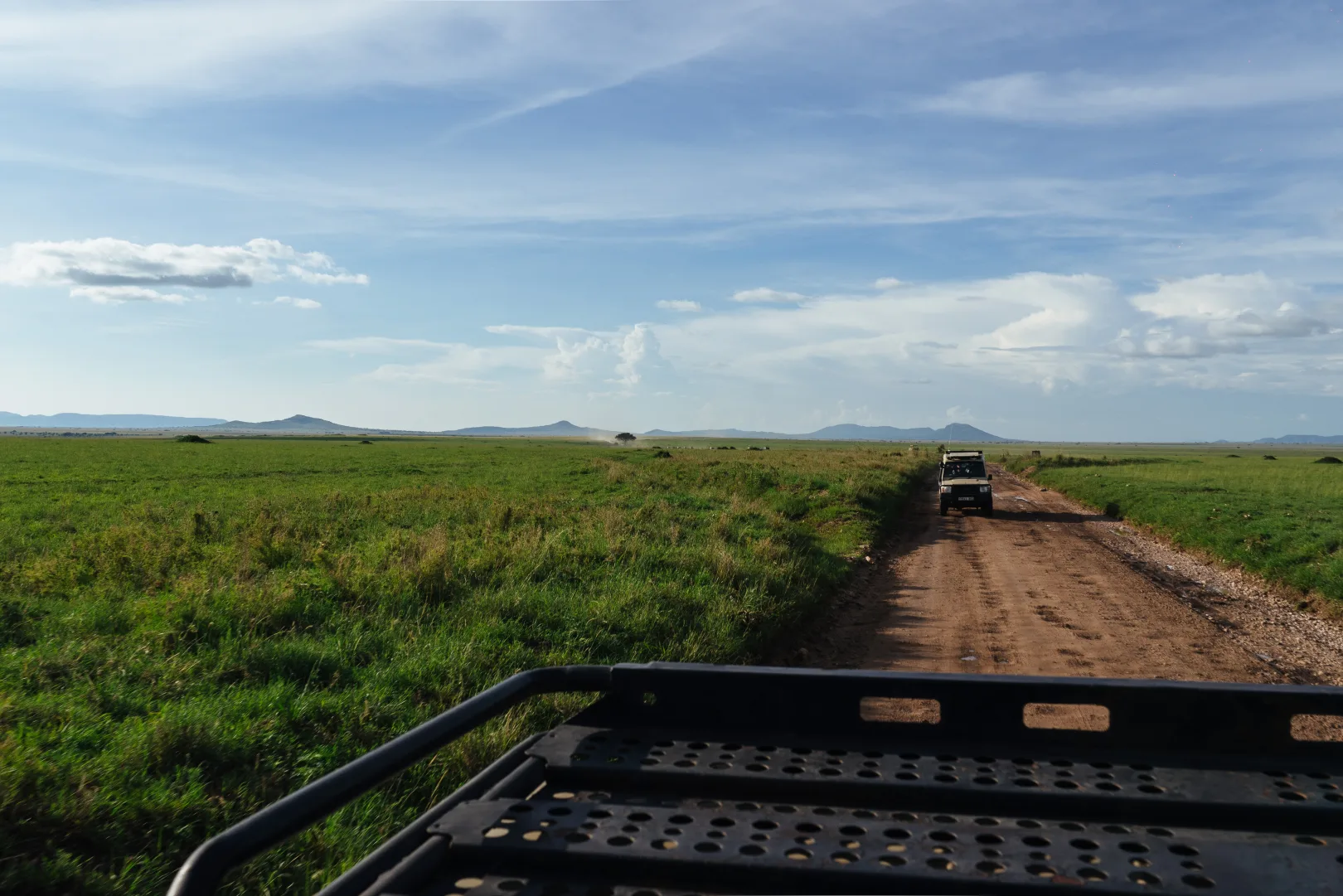
The Serengeti at first light — experienced from a private position, in silence, before the park opens to traffic
Night Drives: The Experience You Cannot Have Inside the Park
If there is a single experience that defines a private conservancy safari, it is the night drive. Inside the national parks, driving after dark — even with a spotlight — is prohibited. This rule exists for legitimate safety and conservation reasons, but its effect is to blind you to the half of animal behaviour that happens after sunset.
Leopards hunt primarily at night. Lions are significantly more active after dark. Hyenas operate largely under the cover of darkness. The civet, the genet, the aardwolf — nocturnal creatures that you will never see on a daytime safari — appear in spotlight beams with surprising regularity once the sun is down.
On a night drive, you might follow a leopard through riverine forest for an hour, watching its behaviour change as it transitions from daytime rest to active hunting mode. You might find a pride of lions that was invisible during the day, now fully alert and mobile. The landscape you thought you knew from the daylight hours turns out to have a second, entirely different cast.
Night drives are led by guides who know the conservancy intimately — who know where the territorial boundaries are, which roads to take, and how to position the vehicle for both safety and the best view. The experience requires trust in your guide. That trust is built over years of working the same ground.
Walking Safaris: Present in the Wilderness
There is no adequate preparation for the first time you walk in big game country. The sensation of alertness, of genuine presence, of your nervous system becoming fully activated, is unlike anything you can replicate from inside a vehicle. You hear everything. You smell everything. Your guide, armed and experienced, reads the landscape at a level that takes years to develop.
A walking safari in a private conservancy typically lasts two to three hours, beginning at first light. You move slowly, stopping to examine tracks, dung, territorial marks — the forensic layer of wildlife behaviour that is invisible from a vehicle. Your guide reads the signs and narrates the story of the morning so far: where the elephant herd moved through, which direction the buffalo group is heading, what the leopard was doing in the night.
The goal of a walking safari is not to track dangerous animals at close quarters. It is to experience the landscape at a pace and a proximity that is simply not possible from inside a vehicle. The buffalo that would be a hazard at close range are given wide berth. The elephants are watched from a distance that is safe and respectful. The experience is immersive without being reckless.

The golden hour on the open Serengeti — the same light, the same plains, but experienced in complete solitude
The Bobby Safari Approach to Conservancy Safaris
We have been working Tanzania's private conservancies for decades. Our relationships with the management of the key properties are genuine — built on consistent bookings, mutual respect, and a shared understanding of what conservation requires.
We do not have exclusive arrangements with any conservancy property. We do not receive commissions or kickbacks for directing guests to specific camps. We recommend based on what we believe is right for each guest — their group composition, their interests, their timeframe, and their budget. If the conservancy camp we suggest is not appropriate for your requirements, we will tell you, and suggest an alternative.
For guests combining a conservancy stay with time in the national parks — which is our most common recommendation — we manage the logistics seamlessly. The conservancy camp, the park lodges, the internal flights, the vehicle transitions: all of it designed around a single, coherent itinerary rather than assembled from separate bookings.
The conservancy safari is not a package. It is a designed experience, built around a conversation about what you most want from your time in Tanzania. Begin that conversation with us.