

A Tanzania safari costs somewhere between $800 and $15,000 per person per day. That is not a helpful answer — but it is an honest one. The range exists because the product varies enormously, and the difference between a safari at $800 and one at $8,000 per day is not simply a matter of nicer tents. It is a different category of experience entirely.
This guide breaks down what Tanzania safari pricing actually looks like, what drives the cost at each tier, and what the differences mean in practice. We have been operating safaris in Tanzania since 1978, and we believe travellers make better decisions when they understand what they are actually comparing.

The difference between safari tiers is not primarily accommodation — it is access, privacy, and the operational model that produces a fundamentally different wildlife experience
The Four Tiers of Tanzania Safari Pricing
Tanzania safari operators broadly segment into four tiers. Each produces a different experience, serves a different traveller, and reflects a different set of operational decisions.
Value Tier
$800 – $1,500 per person per day
Fixed-departure group safaris, shared vehicles, package itineraries. You travel with other guests, often in vehicles carrying 6-8 people. Accommodation is at comfortable lodges and permanent tented camps. The itinerary is set in advance.
What You Get
A solid introduction to Tanzania's major parks. You will see wildlife. The guide will be professional and competent. The wildlife viewing will be competitive — you will see the same sightings as everyone else, at roughly the same time, from roughly the same angle.
What You Sacrifice
Privacy. Flexibility. Access to conservancies or private areas. The guide's undivided attention. The ability to linger at a sighting for two hours when something extraordinary is unfolding. The sense that the safari was designed for you rather than assembled from a menu.
Premium Tier
$1,500 – $3,000 per person per day
Private safari with a dedicated vehicle and guide. Accommodation at character lodges and high-quality tented camps. The itinerary is typically bespoke or semi-bespoke. This is where the experience starts to feel genuinely personal.
What You Get
Your own vehicle, your own guide, your own pace. You can linger at sightings, adjust the itinerary around what you most want to see, and have conversations with your guide that develop over multiple days rather than reset every morning.
What You Sacrifice
True exclusivity inside the national parks. At busy times, you will still encounter other vehicles at major sightings. Access to private conservancies is limited. The most extraordinary wildlife areas — the ones that require long-term operator relationships — are still out of reach.
Luxury Tier
$3,000 – $8,000 per person per day
Fully private, fully bespoke itineraries with dedicated vehicles and senior guides. Accommodation at the finest camps — often small, exclusive-use properties with outstanding access to wildlife. Operators at this tier have long-standing relationships with specific camps and conservancies.
What You Get
Senior guides with decades of field experience. Access to private conservancies where vehicle numbers are strictly capped. Accommodation where the wildlife access is exceptional — camps positioned inside conservancies at locations simply not available to standard operators.
What You Sacrifice
The absolute pinnacle of exclusivity. At peak season in the most sought-after areas, even luxury-tier operators can find the competition for the best sightings intense.
Ultra-Luxury Tier
$8,000 – $15,000+ per person per day
The top of the market. Exclusive-use camps, often for single parties only. Guides who have spent decades building the specific knowledge that transforms a game drive into a genuine immersion. Operators at this level own or exclusively control access to the finest wildlife terrain.
What You Get
The Serengeti at its most private. The best guides in Tanzania, if not Africa. Access to experiences — night drives, walking safaris, exclusive conservancy dinners, rhino tracking on foot — that are simply not available at any other tier.
What You Sacrifice
Nothing, at this level. This is the ceiling of what Tanzania safari can offer — and for travellers who have done it all, it is difficult to describe in terms that do not sound like hyperbole.
“The safari you choose is not the accommodation you sleep in. It is the vehicle you drive in, the guide beside you, and the land you are given access to.”
What Actually Drives the Cost
Most people assume safari pricing is driven primarily by accommodation. The tent versus the suite, the shared bathroom versus the private plunge pool. Accommodation does matter — but it is not the primary driver of the difference between tiers.
Park fees are the largest single cost component in Tanzania. The Serengeti charges $60-80 per person per day depending on the season. Ngorongoro charges $70 per person per day plus a vehicle fee. For a six-day northern circuit, park fees alone add $600-900 per person to the total cost.
Guide quality and compensation is the second major driver. A senior guide with fifteen years of experience commands a salary substantially higher than a newly trained guide. That difference is real, and it is reflected in the quality of what you see and learn. At the ultra-luxury tier, guides are often compensated at levels that reflect their rarity.
Vehicle ownership and maintenance matters more than it sounds. Operators who own their fleet outright maintain it properly. Operators who rent vehicles or run older fleets cut costs at the expense of reliability and comfort. The safari vehicle is your primary working environment for the duration of your trip.
Camp and conservancy relationships are accumulated over decades and represent genuine competitive advantage. The camps with the best wildlife access — those positioned inside private conservancies with rights to activities like night drives and walking safaris — are not available to any operator who shows up with a booking.
Group size is the arithmetic of safari economics. A vehicle carrying six guests generates six times the revenue of a private vehicle. Private safari pricing reflects the reality that one party is paying for the entire operational cost rather than sharing it. This is not a luxury markup — it is the actual cost difference between shared and exclusive use.
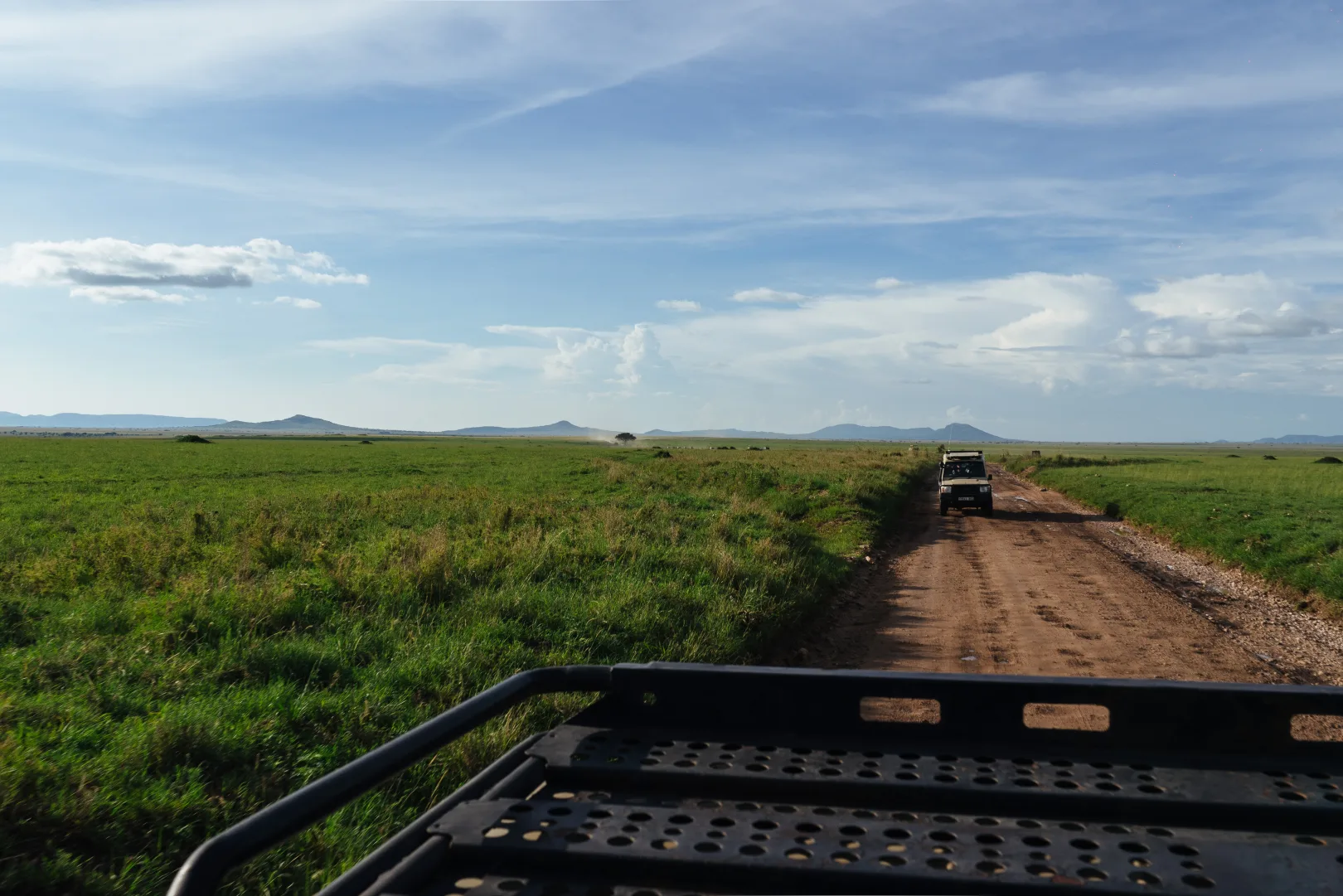
The Serengeti does not care what you paid to get here. But your experience of it depends entirely on how you arrived — and who you are travelling with
Sample Itineraries and What They Cost
To make this concrete, here is what a safari at different tiers actually looks like in practice. These are real itinerary patterns based on what Bobby Safari and comparable operators offer.
6 Days — Northern Circuit
Total for two: $9,600 – $18,000 for two
Includes: Shared 4x4 with AC, professional English-speaking guide, en-suite tents at quality lodges, all meals, park fees, airport transfers
Excludes: International flights, tips, alcohol, travel insurance, visa, personal purchases
Competitive itinerary covering Serengeti, Ngorongoro, and Tarangire. The guide will be competent; the vehicle shared with other guests.
8 Days — Northern Circuit + Conservancy
Total for two: $24,000 – $48,000 for two
Includes: Private 4x4, dedicated senior guide, en-suite tents at character lodges and premium camps, all meals, park fees, one conservancy night drive, airport transfers
Excludes: International flights, tips, alcohol, travel insurance, visa, balloon safari
The private vehicle and dedicated guide transform the experience. The conservancy night drive introduces an entirely different dimension of wildlife encounter.
10 Days — Northern Circuit + Private Conservancies
Total for two: $60,000 – $120,000 for two
Includes: Private vehicle, senior guide, exclusive-use camp in private conservancy for 3 nights, premium lodges for remaining nights, all meals, all park fees, all conservancy fees, all activities including walking safari and night drive, airport transfers
Excludes: International flights, tips, travel insurance, visa
This is where the experience changes category. The conservancy camp — with night drives, walking safaris, and a vehicle density that is a fraction of the national park — is not accessible at lower tiers.
14 Days — Full Immersion
Total for two: $224,000 – $420,000 for two
Includes: Everything. Private aircraft between destinations if applicable, exclusive-use camps throughout, the finest senior guide in Tanzania, all activities including specialist experiences like rhino tracking, helicopter transfer to Serengeti for sunset, all dining, all beverages, all fees and taxes.
Excludes: International flights, tips (guidelines provided), travel insurance, visa
This is the ceiling. Not everyone needs or wants this. But for travellers who have done safaris at every tier and want to understand what Tanzania is genuinely capable of delivering — this is the answer.
Why Tanzania Costs More Than Its Neighbors
First-time safari travellers often notice that Tanzania appears more expensive than Kenya or South Africa for comparable park visits. This is real, and it deserves an honest explanation.
Tanzania's park fee structure is the most significant factor. The Tanzania National Parks Authority sets fees that are higher than Kenya's and substantially higher than South Africa's. These fees fund anti-poaching operations, ranger deployment, road maintenance, and community revenue-sharing — they reflect a genuine commitment to conservation financing that is more rigorous than most other African countries.
Tanzania also has a stricter regulatory environment for safari operators. Vehicle standards, guide certification requirements, and camp licensing are more demanding. This raises operating costs but also raises the baseline quality of what operates in Tanzania compared to markets with lighter regulation.
The conservation model is different. Tanzania has invested heavily in private conservancy networks — community-owned land bordering national parks that is leased to exclusive-use camps under strict sustainability guidelines. The conservancy fees that fund local communities and incentivise wildlife habitat retention are built into the cost of staying at these properties. Kenya does not have an equivalent model at comparable scale.
The result is that Tanzania is genuinely more expensive — but the premium buys something real. The wildlife densities, the conservation integrity, and the quality of guide training in Tanzania are a consequence of this investment. Travellers who understand this typically consider it money well spent.
Ngorongoro Crater — one of the most wildlife-dense environments on earth, accessible year-round, and a significant component of what a Tanzania safari costs
How to Decide What Tier Is Right for You
This is not a question that has a universal answer. The right tier depends on your budget, your expectations, and what you most want to get from the experience.
If this is your first safari and the budget is genuinely constrained, a value-tier safari is still a remarkable experience. Tanzania's wildlife is extraordinary regardless of operator tier. You will see the Serengeti, you will see the Ngorongoro Crater, and you will have experiences that will stay with you for life. The guide will be professional. The logistics will work.
If you have safaried before and want something more, or if the experience you are planning is once-in-a-lifetime in a meaningful sense — a honeymoon, a significant anniversary, a trip you are saving specifically for — then the premium tier is almost always the right call. The difference between a shared-vehicle and private-vehicle safari is not cosmetic. It is the difference between watching something and being in it.
If you have done multiple safaris and are specifically seeking the finest version of the experience, the luxury and ultra-luxury tiers offer something that simply cannot be replicated at lower price points. The conservancy access, the guide depth, the night drives and walking safaris — these are not upsells. They are categorically different experiences.
The worst outcome is not choosing a lower tier. The worst outcome is choosing a tier that creates expectations the experience cannot meet. A well-matched safari — where the tier, the itinerary, and the operator all align with what the traveller is actually seeking — produces a sense of rightness that is its own form of luxury.
The Serengeti has been producing extraordinary wildlife encounters for millions of years. The question of what it costs is really a question of how you want to experience it. We have been helping travellers answer that question — and then designing the safari that matches the answer — since 1978. If you would like to begin that conversation, the Kassim family is ready to listen.
Questions
About Tanzania Safari Pricing
What is the actual cost of a Tanzania safari per day?
Tanzania safari costs vary from $800 per person per day at the value tier to $3,000-$8,000 at the luxury tier, and $8,000-$15,000+ at the ultra-luxury level. The difference between tiers is not primarily accommodation — it is the operational model: private vehicles, exclusive-use camps, guide depth, and access to conservancies and areas that standard operators cannot reach.
Why are Tanzania safaris more expensive than Kenya?
Tanzania's conservation fee structure is significantly higher than Kenya's — park fees in the Serengeti run $60-80 per person per day versus Kenya's $50-60 for comparable parks. Tanzania's stricter conservation model limits vehicle numbers at wildlife sites, restricts access to some areas, and requires higher operator standards. The result is a more authentic wilderness experience at a higher operating cost.
Is a Tanzania safari worth the cost?
A properly designed Tanzania safari — with the right operator, the right guide, and the right allocation of time — is one of the most extraordinary experiences accessible to a traveller. A poorly designed safari at any price point can feel like a disappointment. A properly designed one at the right tier feels like something that cannot be replicated anywhere else on earth.
How many days should I budget for a Tanzania safari?
We consider six days the minimum for a genuine northern circuit experience. Eight to ten days allows for the Serengeti, Ngorongoro, and at least one private conservancy. Twelve days or more opens up the southern parks or a Zanzibar extension. The cost per day tends to decrease slightly as length increases, as fixed costs are spread across more days.
What is not included in a typical Tanzania safari price?
International flights, travel insurance, visas ($50 for most nationalities), gratuities to guides, personal purchases, and sometimes adventure activities not in the core itinerary (such as balloon safaris at $500-600 per person). Alcohol at camps is typically not included. At the ultra-luxury level, most items can be pre-arranged and often included.
How far in advance should I book to get the best Tanzania safari price?
For the August to October Great Migration season, twelve months ahead is not excessive — the best private camps and conservancies fill twelve to eighteen months out. For general wildlife viewing, six months is typically sufficient. Early booking does not reduce the per-day rate, but it secures access to the experiences that make a safari worth taking.