

The first time Don Kassim brought guests to what is now the Grumeti Reserve, there was no road in. The only way in was a four-hour walk from the nearest village, carrying everything on your back. That was 1979, before the wildlife quotas, before the photographic tourism era, before anyone outside a small circle of Arusha guides knew what lived in those vast western grasslands.
The Grumeti Reserve is still, in many ways, that place. Not unchanged — the world has moved around it — but it has remained structurally intact in a way that very few wildlife environments in Africa have managed. Four hundred thousand acres of continuous wilderness, shared by an extraordinary density of wildlife, and visited by a fraction of the people who pass through the Serengeti each season.
“The Grumeti is what the Serengeti was before the world discovered it. Once you have spent time there, you understand why we have never needed to advertise it.”
Where Grumeti Lives on the Map
The Grumeti Reserve occupies the Western Corridor of the Serengeti ecosystem — a tongue of grassland that runs between the main Serengeti plains and the edge of the park boundary, stretching west toward the eye of the Serengeti watershed. The Grumeti River itself is the geographic spine of the reserve: a permanent watercourse that draws wildlife year-round, and during the migration season becomes one of the most dramatic wildlife theatres in Africa.
The reserve is contiguous with the Serengeti — there is no physical barrier between them. Wildebeest, zebra, and gazelle move freely across the boundary in both directions. But the management regime is entirely different. Where the national park operates under Tanzania National Parks Authority rules, the Grumeti Reserve is managed under a conservation framework that allows the practices that define a truly exceptional safari: off-road tracking, night driving, and walking.
The nearest major town is Mugumu — a small centre that most visitors to the Serengeti never see, which is precisely the point. Access to the reserve is managed carefully, with a limited number of operators holding concessions. This is not an accident. The people who designed the reserve understood that the thing that makes Grumeti exceptional would be destroyed by volume.
The Grumeti grasslands at dawn — four hundred thousand acres of wilderness that most safari visitors to Tanzania never see
The Great Migration Through Grumeti
When the world speaks of the Great Migration, the Mara River crossing dominates the narrative. It is dramatic — there is no question — and the images of crocodiles and thrashing wildebeest are deservedly iconic. But the Grumeti River crossing, which occurs three to four weeks earlier than the Mara crossings, is in some ways more extraordinary.
The Grumeti crossings happen in a narrower channel. The river is broader but shallower in places, and the wildebeest queues — literally thousands of animals lining the bank, working up the courage to enter the water — can last for hours. The Nile crocodiles in the Grumeti are enormous, some estimated at over sixty years old. The tension of the waiting is something that no game drive script could invent.
The Cassin's lovebirds are a small, vivid green parrot found only in this corridor of Tanzania — a bird that most visitors to the Serengeti never encounter. During the migration months, when the herds are concentrated along the river, these birds feed on the dropped dung, going about their lives in a counterpoint of scale that reminds you how much is happening simultaneously in any given moment on the plains.

The wildebeest concentrations along the Grumeti River — the crossing here predates and in some ways surpasses the famous Mara River drama
The Wildlife of the Grumeti
What distinguishes the Grumeti Reserve from the broader Serengeti ecosystem is not the presence of different species — the cast of characters is essentially the same — but the density and behaviour of certain populations. The lion pride that inhabits the Grumeti River corridor is one of the largest in the Serengeti-Mara ecosystem. The leopard population is exceptional — partly because the reduced vehicle pressure means leopards here have not developed the engine-habituation that makes them harder to find in busier areas.
The topi and Coke's hartebeest populations in the Grumeti are the largest concentrated herds in East Africa. These are antelope species that most first-time safari visitors have not heard of, but once pointed out — the topi's deep chestnut sheen, the hartebeest's peculiar angular profile — they become objects of fascination. They are extraordinarily fast, and watching them run is a reminder that the antelope world is as varied and specialised as anything in the predator realm.
Giant-tented tortoises inhabit the rocky outcrops — ancient creatures, some estimated at over eighty years old, that plod through the grass with the unhurried indifference of something that has no real enemies left. These are not the same species as the Galapagos giant tortoises, but they share the same quality of having outlived whatever selected them for extraordinary longevity.
Leopard in the Grumeti — the reduced vehicle presence means these cats are less habituated and more naturally behaviourally alert
Why Grumeti Is Different From the National Parks
The distinction between a private conservancy like Grumeti and the national parks is the single most important thing to understand when planning a Tanzania safari. It determines what you are permitted to do, how close you can get, what you are likely to see, and how the experience will feel.
In the Serengeti, vehicles must remain on designated roads. Game drives are permitted only in morning and afternoon blocks. Off-road driving — following a leopard into thick bush, tracking a lion pride off the track — is prohibited. Night drives are not permitted. Walking is not permitted.
In the Grumeti Reserve, none of these restrictions apply. Your guide drives where the animals are, not where the road goes. If a leopard is half a kilometre from the track, across a dry riverbed and into a stand of umbrella acacia, you follow. When the sun sets, the game drive continues — because the rules that apply in national parks do not apply here.
This is not a minor operational difference. It is a fundamental change in what kind of experience is possible. The animals that are most worth seeing — leopards, lions, hyenas on a hunt, black rhinos — are most active in the hours around dawn and dusk. In a national park, these are exactly the hours when you are required to be driving back to camp. In Grumeti, you stay. For those specifically seeking Tanzania's most endangered species, private conservancies like Grumeti offer access to guided rhino tracking experiences that national parks cannot.
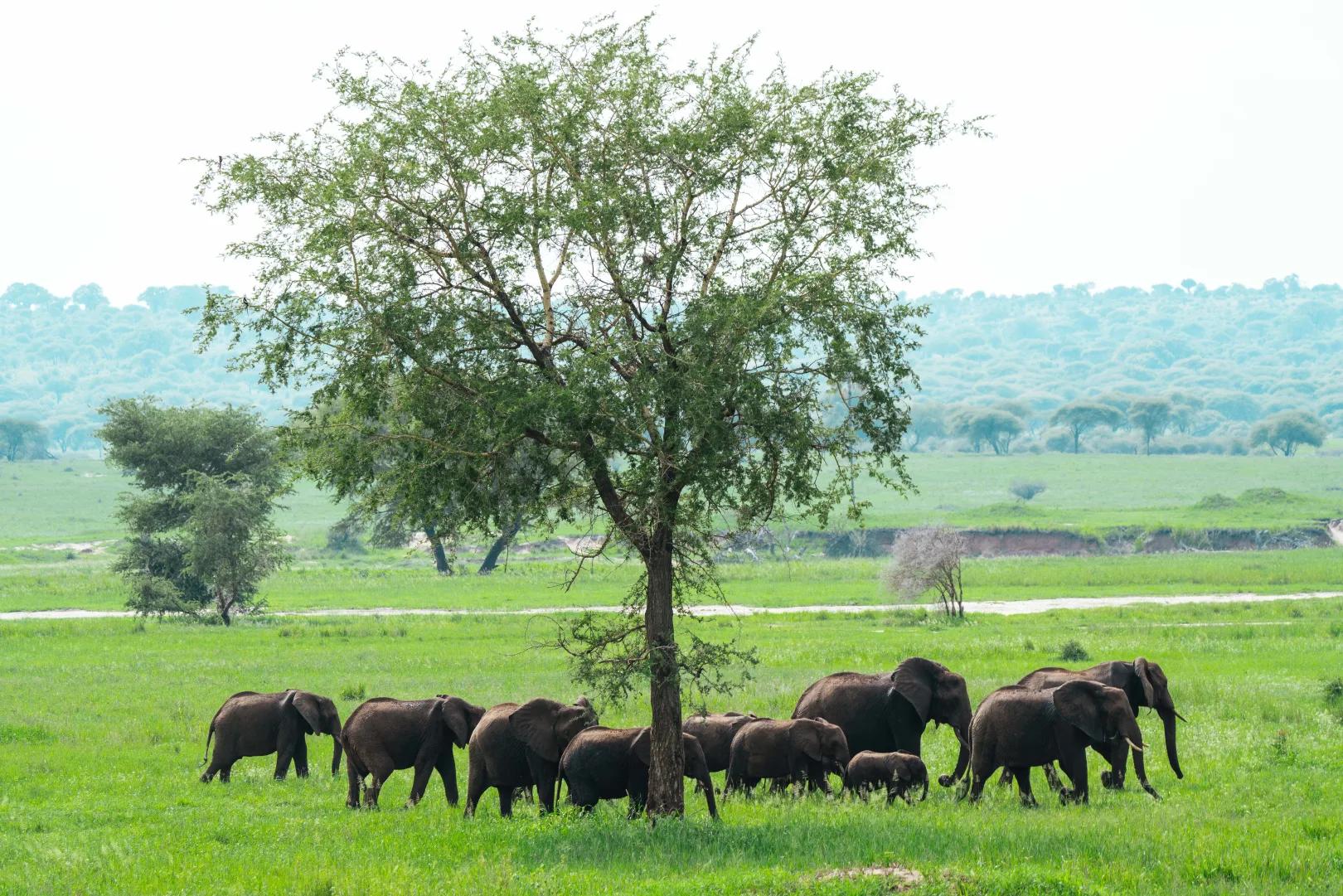
Elephant crossing the Grumeti River at sunset — the river draws wildlife year-round, not just during migration season
The Camps of Grumeti
The Grumeti Reserve holds a small number of camps — deliberately limited, by design. The concession holders understand that the thing they are selling is the quality of the wilderness experience, which degrades directly in proportion to the number of vehicles in the landscape at any given time.
The camps are permanent tented structures — not the fly-campingstyle of the most remote conservancies, but substantial canvas setups with proper beds, en-suite bathrooms, and the kind of camp furniture that signals this is not wilderness roughing. Some have been in the same location for decades, built around specific trees and rock formations that are now as much a part of the landscape as the animals themselves.
The camp that Bobby Safari has used most consistently over the years was built by a former wildlife officer who knew the Grumeti better than anyone alive. His understanding of where the leopards denned, where the lion pride liked to rest during the heat of midday, which sections of river held the largest crocodiles — this accumulated knowledge is not in any book. It is carried in the memory of guides who spent decades reading the same landscape every day. When you go to Grumeti with Bobby Safari, you access that knowledge.
The Grumeti Reserve is not well-known because it was never designed to be. The operators who hold concessions there have always preferred it that way. What the Kassim family discovered in 1979 — a landscape of extraordinary richness that felt like it belonged to no one — is still there, still intact, still available to guests who want something that most visitors to Tanzania will never see. Speak with Don about whether Grumeti belongs in your safari.
Questions
About the Grumeti Reserve
Where is the Grumeti Reserve and what makes it special?
The Grumeti Reserve sits immediately west of the Serengeti in north-western Tanzania, covering approximately 400,000 acres of wilderness. What makes it special is the combination of extraordinary wildlife density — including some of the largest herds of topi and Coke's hartebeest in Africa — and the complete absence of the tourist traffic that defines the national park corridors during peak season.
Is the Grumeti Reserve part of the Serengeti?
The Grumeti Reserve borders the Serengeti but is a separate, privately managed conservation area. This distinction matters enormously: private reserves operate under different rules than national parks, allowing off-road driving, night drives, and walking safaris that are prohibited in the Serengeti. The wildlife is continuous across the boundary — but the experience is entirely different.
What wildlife will I see in the Grumeti Reserve?
The Grumeti Reserve holds exceptional populations of lion, leopard, and spotted hyena, as well as the largest herds of topi and Coke's hartebeest in East Africa. Giant-tented tortoises — some over 80 years old — inhabit the rocky outcrops. The area is one of the finest for leopard viewing anywhere in Tanzania, largely because the absence of many vehicles means the leopards are less habituated to engines.
When is the best time to visit the Grumeti Reserve?
The dry season from June to October coincides with the Western Corridor of the Great Migration — wildebeest and zebra cross the Grumeti River itself, facing enormous Nile crocodiles in dramatic crossings. For general wildlife viewing, July through September is exceptional. The green season from November to May offers spectacular birding, beautiful green landscapes, and dramatically fewer vehicles.
How does Grumeti compare to the main Serengeti for luxury safari?
The Serengeti national park is extraordinary — but it is also increasingly busy during peak season, with multiple vehicles at major sightings. The Grumeti Reserve offers the same ecosystem, the same wildlife, the same vast scale — but with the privacy and off-road access that a luxury safari requires. For guests who want to feel that they are the only people in a landscape, Grumeti is the answer that the Serengeti cannot always provide.