

A $20,000 safari and a $50,000 safari can use the same camps. They can follow the same routes through the Serengeti, sit at the same confluence of rivers where the wildebeest cross, and photograph the same leopard in the same sausage tree. The wildlife does not know what you paid. What separates the two experiences is what happens around the wildlife — the operational infrastructure that positions you correctly, the intelligence that tells you where to be, and the human quality of the people guiding you. These are not cosmetic differences. They are the difference between an excellent safari and a genuinely unrepeatable one.
Operational Capability
The Aircraft Question
Tanzania's safari infrastructure depends on light aircraft — the distances between the Serengeti, Ngorongoro, Tarangire, and the southern conservancies are too great for ground transport, and the landing strips are too rough for jets. Every operator uses aircraft. Not every operator owns or controls theirs.
A scheduled charter operates on fixed routes and published timetables. You arrive at the airstrip when the aircraft arrives — often after stops at two or three other camps — and you travel at the speed of the schedule, not the pace of your experience. If your morning game drive runs long because a pride of lions is hunting, you miss your connection. The aircraft does not wait.
A dedicated private aircraft — one that operates for your party alone — waits. It departs when you are ready, can redirect mid-route to a different landing strip if conditions change, and can hold position over a wildlife sighting while you finish photographing it. For the Tanzania safari where the best moments are unpredictable, that flexibility is operational capability in its most tangible form.
Ask any operator directly: do you operate your own aircraft, or do you charter through a third-party operator? The answer tells you whether aircraft logistics are part of your planned experience or a variable you are trusting to someone you have never met.
Private aircraft access — the operational layer that makes door-to-door safari seamless at the ultra-luxury tier.
Operational Capability
The Ground Intelligence Gap
The Serengeti is 14,750 square kilometres. No guide, however experienced, can track everything happening across that landscape from memory alone. The question is not whether an operator uses intelligence — it is where that intelligence comes from and how quickly it moves.
Top-tier operators maintain active radio networks across their vehicle fleet and conservancy partnerships. When a guide reports a leopard with a fresh kill in the western corridor, that information flows immediately to every other vehicle within the network — not as a general broadcast, but as a targeted alert to guides positioned within a reasonable drive. Your operator does not guess where the wildlife is. They know, because their network is telling them.
A camp-employed guide is exceptional at reading the landscape immediately around them — spoor, alarm calls, bird activity, the behaviour of herbivores. They are operating with their own eyes and ears. A dedicated operator network adds the eyes and ears of every other guide in the field. The combination is what makes repositioning decisions fast and accurate.
Private conservancy access changes the intelligence equation further. In national parks, wildlife timing is constrained by regulation — game drives operate from roughly 6:30 am to 6:30 pm. In private conservancies, there are no such restrictions. A top operator with long-standing conservancy access can position guests during the golden hours that park rules keep off-limits to the majority of visitors.
Operational Capability
The Concierge Layer
The guide is the single most important variable in any safari. But not all guides are employed the same way — and the employment model shapes the quality of the relationship you have with them before, during, and after your trip.
A dedicated naturalist guide employed by your operator works with you before you arrive. They have read your initial enquiry, spoken with you about what you want to see, and arrived with a specific research brief: your target species, your photography interests, your physical requirements, your preferred pace. They are not encountering you for the first time at the airport.
In the field, a dedicated guide makes decisions independently. They do not radio back to a camp manager for permission to deviate from a route, wait for a supervisor's approval to position the vehicle differently, or follow a fixed itinerary because that is what the operator sold you. They are operating with full authority and full accountability — and they know your trip is their reputation.
After the safari, a dedicated naturalist compiles a detailed field journal specific to your experience: a curated species list with behavioural notes, a photographic record of notable sightings, and a summary of what you observed over the days you were together. This is not a camp-generated checklist. It is a document that acknowledges your specific journey — and it is only possible because the guide was working for your operator, not for the camp you stayed in.

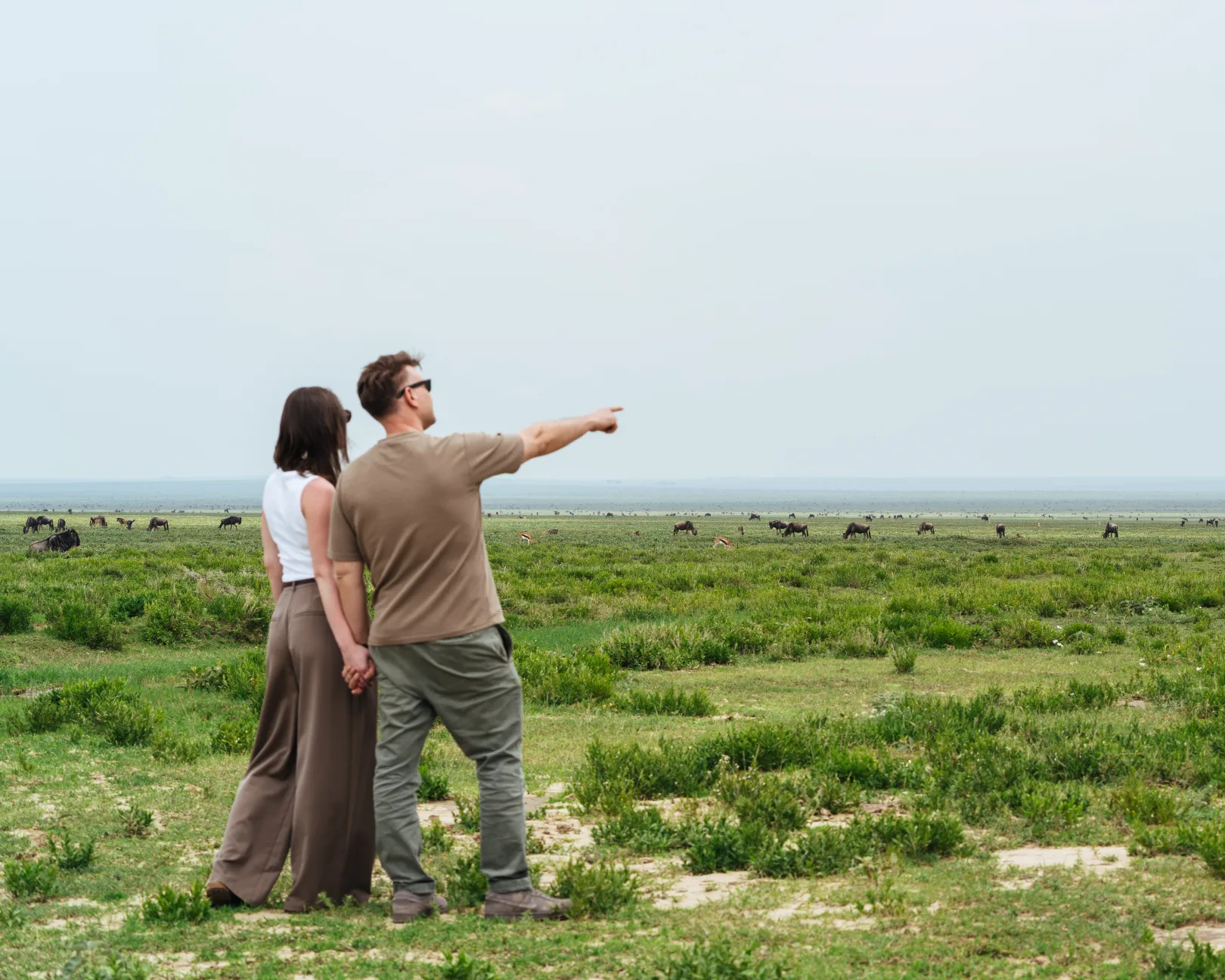
Dedicated naturalist guides — the human layer that defines what an ultra-luxury safari actually feels like.
Before You Sign
The Five-Question Test for Any Ultra-Luxury Operator
1. Do you operate your own aircraft, or charter through a third party?
Charter introduces variables — schedule changes, aircraft substitutions, pilots unfamiliar with Tanzania strips — that a dedicated operation eliminates entirely.
2. Are your guides full-time employees or contracted seasonally?
Full-time employees have institutional knowledge of your operator's standards, conservation values, and client preferences — not just field skills.
3. What is your real-time wildlife intelligence network?
A genuine network means guide-to-guide radio communication across your fleet and conservancy partners, not just a guide's personal knowledge of one area.
4. Which private conservancies do you have access to, and how many guest beds do those concessions accommodate?
Capacity is the clearest indicator of genuine exclusivity. A conservancy with twelve beds is different from one with sixty — and the difference is felt every time you are in the field.
5. Can you share a sample trip journal from a recent client?
A professional operator with confident guiding will have this ready to share. The content and specificity of the journal tells you exactly what kind of experience they deliver.
The Bobby Safaris Approach
Ultra-Luxury Is an Operational Philosophy, Not a Price Point
At Bobby Safaris, every element described above — aircraft, intelligence, guiding, conservancy access — is operated directly by our own team. We do not broker camps, we do not sub-contract guiding, and we do not use third-party charter networks. Our approach is built around the principle that the only way to guarantee consistent quality at the ultra-luxury level is to own the operation end-to-end.
If you are evaluating operators for a Tanzania safari at the ultra-luxury tier, we welcome that evaluation. Ask the five questions above of any operator you are considering — and compare the answers directly. We believe the comparison will be clear.
Continue Reading
Destination
Tanzania Ultra-Luxury Safari
Why Tanzania sits at the top of the ultra-luxury safari world.
Our Approach
Our Difference
What Bobby Safaris operates directly — and why that matters.

bespoke
Bespoke Safari
How a Bobby Safari is designed — entirely around you.
The Complete Guide
Ultra-Luxury Safari in Tanzania
The full guide to ultra-luxury safari in Tanzania — where operational depth actually shows up.