

Elephants are not simply large. They are intelligent, emotional, deeply social animals whose family bonds span decades and whose death responses — returning to the remains of family members, touching the bones with their trunks — have been documented by researchers as evidence of grief. When you watch a matriarch lead her family across the plains, she is drawing on a lifetime of accumulated knowledge about where water was found during drought years, where it is safe to go, which trees provide the best bark in different seasons.
Tanzania holds one of the healthiest elephant populations in Africa — the result of decades of intensive anti-poaching work in the Serengeti-Mara ecosystem. The herds you encounter here are not animals in a sanctuary. They are functioning elephant societies, and the experience of watching one is one of the few genuinely wild experiences still available on Earth.
"When an elephant family crosses the Tarangire River, the matriarch is not leading. She is remembering — decades of knowledge in the decisions she makes moment by moment."
Elephant Society — The Matriarch's Knowledge
Elephant herds are matriarchal societies. The oldest female — the matriarch — leads the family group, drawing on a lifetime of accumulated knowledge to make decisions about movement, foraging, water sources, and threats. Her daughters and their offspring form the core of the group; adolescent males leave to form bachelor groups or roam independently.
The matriarch's knowledge is real, not metaphorical. Studies have documented that matriarchs who lived through severe droughts lead their families to water sources they discovered as younger animals — knowledge that would otherwise be lost when they die. A matriarch's death can affect the survival rate of her entire family group for years, because the accumulated knowledge she carried could not be transferred to a successor.
When you watch a matriarch make decisions, you are watching knowledge in operation.
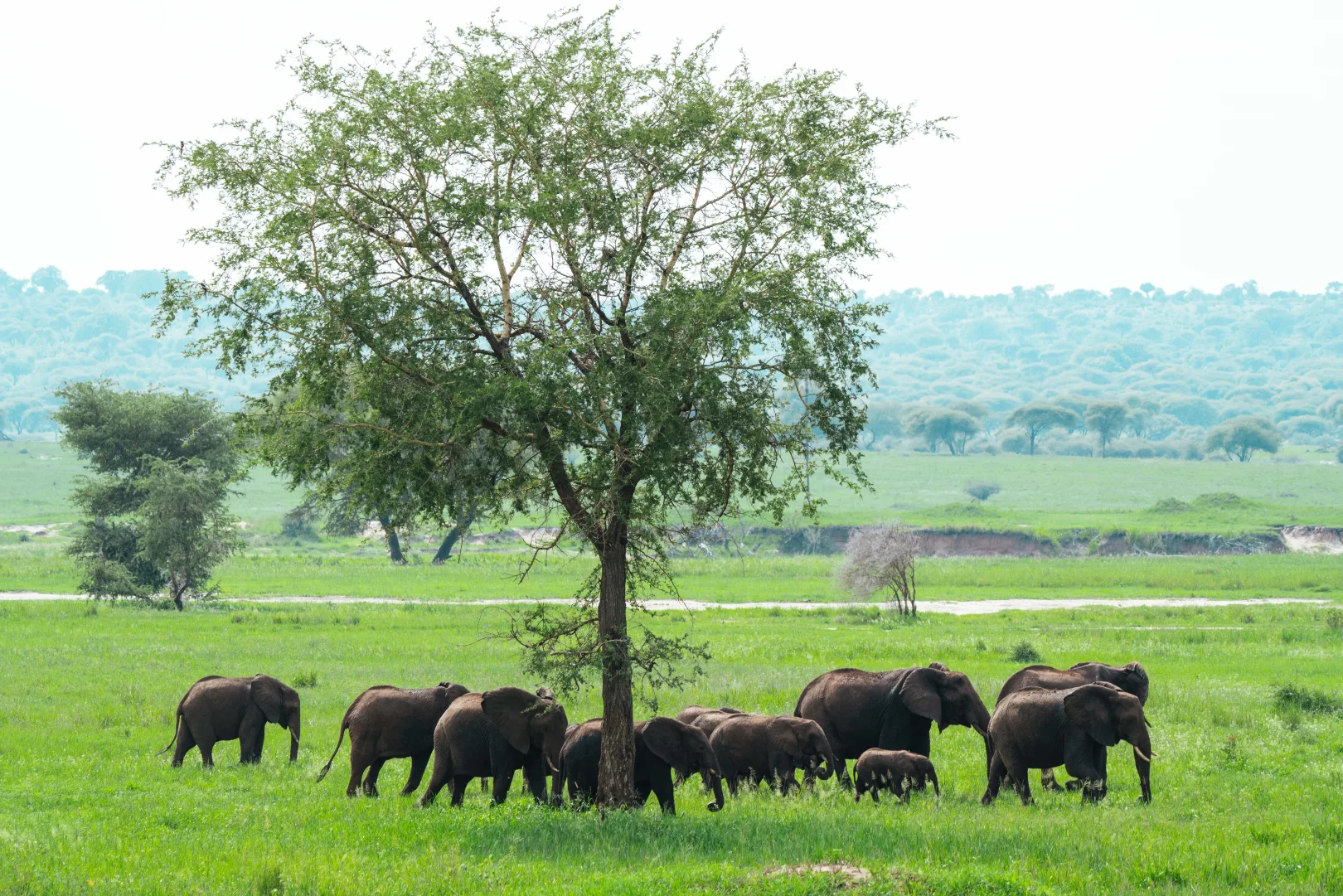
An elephant family in Tanzania — when you watch a matriarch make decisions, you are watching knowledge in operation
Where to Find Elephants in Tanzania
Tarangire National Park — The most reliable elephant viewing in Tanzania. During dry season (June to October), concentrations exceed 3,000 elephants along the Tarangire River. Herds of 200+ crossing the river are common. This is one of the most spectacular wildlife gatherings in Africa.
Serengeti National Park — Elephants are more widely distributed here, with resident populations in the western corridor, northern Lamai Wedge, and central Seronera valley. Encounters are less concentrated but equally extraordinary when they occur.
Ruaha National Park — A remote, undervisited park with large, less-habituated elephant herds. The experience of watching elephants here, without another vehicle in sight, is categorically different from Tarangire.
The Ecological Role of Elephants — Why They Matter More Than Any Other Animal
Elephants are a keystone species — an animal whose role in the ecosystem is so fundamental that its removal causes measurable degradation. They are the engineers of the African landscape in a physical sense: pushing over trees to create clearings, digging waterholes that other animals use during dry season, wearing paths that become corridors for other species.
When elephants are removed from an ecosystem, the ecosystem degrades measurably within a decade. The changes are not subtle: forests thicken beyond what the landscape can sustain; waterholes silt up; species that depended on the clearings elephants created disappear. The Serengeti-Mara ecosystem functions as it does in large part because elephants have been part of it continuously.
The Encounter — Watching Elephants Properly
Watching an elephant herd requires a different quality of attention than most safari visitors bring. The drama is not the point. The point is to witness a society operating — to watch the matriarch's decision-making, the interaction between calves and their protective older siblings, the way the herd reorganizes when a new threat appears.
An adult bull elephant in musth — a periodic reproductive state in which testosterone levels rise dramatically — is one of the most dangerous creatures on Earth. A relaxed family group crossing the Tarangire River with calves walking close to their mothers is one of the most beautiful sights in nature. The same animal, depending on context.
Frequently asked questions
Where is the best place to see elephants in Tanzania?
Tarangire National Park is the most reliable elephant viewing in Tanzania. During dry season (June to October), concentrations exceed 3,000 elephants along the Tarangire River. The Serengeti also holds large elephant populations. Ruaha National Park offers larger, less-habituated herds with very few vehicles.
Why are elephants called the architects of the landscape?
Elephants are a keystone species — their removal causes measurable ecosystem degradation within a decade. They push over trees to create clearings, dig waterholes used by other animals during dry season, and wear paths that become corridors for other species.
What is the matriarch's role in an elephant herd?
The matriarch leads the family group, drawing on accumulated knowledge about water sources, migration routes, and threats. Studies show matriarchs who lived through severe droughts lead their families to water sources they discovered as younger animals — knowledge that would otherwise be lost when they die.
Can you see baby elephants in Tanzania?
Yes — the calving season peaks between January and March. Tanzania's elephant populations have rebounded significantly from the poaching crisis, and family groups are strong and intact. Seeing a newborn calf — still unsteady, trunk exploring the air, protected by a circle of adult females — is one of the most moving experiences an African safari can offer.
How many elephants are in Tanzania?
Tanzania holds approximately 60,000 elephants across all protected areas — the largest population in East Africa. Tanzania has one of the highest rates of elephant population growth in Africa, evidence of effective anti-poaching enforcement and community conservation.
Begin a Conversation
See Elephants with Don
Don has been tracking elephants in Tanzania since 1978. He will tell you which parks offer the best elephant viewing at any given time of year.
Begin a Conversation on WhatsAppContinue reading

Wildlife Guide
Big Five Safari Tanzania
Lion, leopard, elephant, buffalo, rhino — the complete guide to Africa's most iconic wildlife in Tanzania.
Destination Guide
Tarangire National Park Guide
Tanzania's most elephant-dense park — ancient baobabs, dramatic river corridors, and the dry season that changes everything.