

A Big Five safari is the phrase that first appears when someone begins researching an African safari. It is shorthand — five animals named by hunters, not naturalists, that somehow became the definition of what an African safari is supposed to deliver. But the phrase survives for a reason: these are five animals that, encountered properly, do not behave like wildlife encountered in any other context.
Tanzania holds the full set. More than that: it holds them in landscapes where the encounter means something — where an elephant is not a creature in a sanctuary but a presence that has been moving through this specific terrain for longer than the national park has existed. Where a black rhino is not a stroke of luck but the result of decades of intensive conservation work. Where a lion pride operates the way it has always operated, indifferent to the fact that you are watching.
This is the complete guide to a Big Five safari in Tanzania: what the phrase actually means, where to find all five, how to plan a trip that gives you time with each of them, and why Tanzania remains the best place on the continent to attempt the full set.
"The Big Five will not perform for you. They will simply be what they are — and that is more than enough."
What the Big Five Means — And Why It Still Matters
The term was coined by big-game hunters in the colonial era, describing five animals dangerous enough to make a hunter's reputation when pursued on foot. Lion, leopard, rhinoceros, African elephant, and Cape buffalo. The phrase survived the era that created it because it names something real — five animals that reward sustained attention in ways that a browsing session or a zoo visit cannot.
What the phrase obscures is that context is everything. An elephant in a sanctuary is not the same animal as an elephant crossing the Tarangire River with her family group. A rhino in a holding area is not the same animal as a black rhino on the Ngorongoro Crater floor, aware of your vehicle, choosing to continue feeding rather than move. The landscape is not decorative. It is the thing.
Tanzania's national parks and private conservancies offer the full set in conditions that make the encounter genuine. Not a checklist. Not a photo opportunity. A moment in the presence of animals that have been here far longer than the categories we use to describe them.
African Lion — Panthera leo
The Serengeti holds one of the largest lion populations on Earth — approximately 3,500 individuals in the Serengeti-Mara ecosystem alone, the result of one of the longest-running continuous wildlife studies in the world, ongoing since 1966. Lions are the most social of the big cats, living in stable prides with complex matriarchies, cooperative hunting, and lifelong kinship bonds. When you watch a pride under an acacia tree, you are watching a society that has been operating continuously longer than tourism has existed here.
Best viewing: Serengeti National Park, especially the northern Lamai Wedge and western corridor during dry season (June to October). The central Seronera valley year-round.
What to look for: The social dynamics of the pride — which lionesses hunt cooperatively, how the cubs are protected, the relationship between the resident males and the pride females. An experienced guide will read these relationships aloud to you, turning a sighting into a conversation.

A lion in the Serengeti — watching a pride operate is watching a society that has been running continuously longer than tourism has existed here
African Leopard — Panthera pardus
The leopard is the hardest of the Big Five to see consistently, and the reward for finding one is proportionally greater. Leopards are solitary, territorial, and favor dense riverine habitat where they can remain hidden during daylight hours. Unlike lions, they do not congregate in predictable places. The challenge of finding one is part of what makes the encounter extraordinary.
The Serengeti's leopards have been made famous by a single female — nicknamed the Notch Ear female — whose story has been documented across a dozen wildlife photography books. Her cubs, her kills cached in the fork of marula trees, her territorial movements across the central valley: the researchers who have followed her know her as an individual. When you find a leopard in the Serengeti, you are watching a specific animal with a specific history.
Best viewing: Serengeti National Park, particularly the central Seronera valley and the western Loliondo area. Ruaha National Park also has a strong leopard population with far fewer vehicles.
What to look for: The animal's awareness of you. A leopard will often hold your gaze for a moment before choosing to continue its behavior — a transaction between equals that a lion encounter rarely offers.
African Elephant — Loxodonta africana
Tanzania has the largest elephant population in East Africa — concentrated in Tarangire National Park, the Serengeti, and Ruaha National Park — and the herds you encounter here are not circus animals or sanctuary residents. They are functioning elephant societies, with matriarchs drawing on decades of accumulated knowledge about where water was found during drought years, where it is safe to go, which trees provide the best bark in different seasons.
Elephants are the engineers of the African landscape. They push over trees, creating clearings that allow new growth. They dig waterholes that other animals use during dry season. Their paths, worn into the earth over generations, become corridors for other species. When elephants are removed from an ecosystem, the ecosystem degrades measurably within a decade.
Best viewing: Tarangire National Park from June to October when concentrations exceed 3,000 elephants along the Tarangire River. Ruaha National Park for larger, less-visited herds.
What to look for: The matriarch's decision-making. Watch how she leads the family group, how she responds to threats, how the youngest calves are protected in the centre of a moving group.
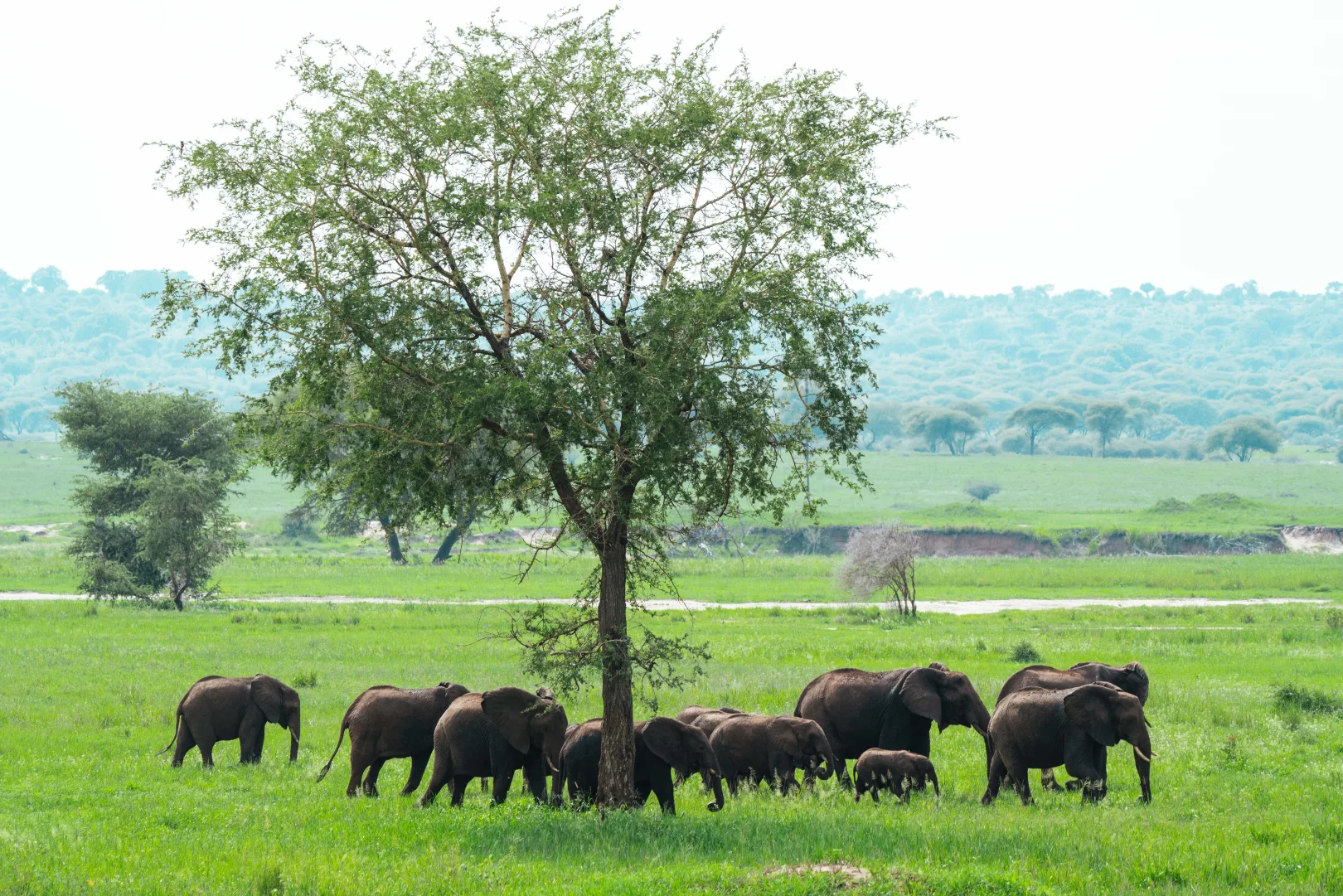
An elephant family group in Tanzania — the matriarch draws on decades of accumulated knowledge about water, safety, and the seasonal movements that have sustained elephant societies for generations
Black Rhinoceros — Diceros bicornis
The black rhino is the most endangered of the Big Five and the most difficult to see. Tanzania's population — concentrated in the Ngorongoro Conservation Area and the Serengeti's remote eastern corridors — numbers around 160 individuals, rebuilt painstakingly from approximately 30 in the 1980s. It remains critically endangered.
Seeing a black rhino in Tanzania requires the right conditions and some luck. They are browsers, feeding on acacia and woody vegetation, and they are found in denser bush than the open plains species. The Ngorongoro Crater floor offers the most reliable viewing in Tanzania: the crater's steep walls provide a natural barrier that allows rangers to monitor and protect the resident population.
Best viewing: Ngorongoro Crater floor. Peak season July to October. Approximately 30 individuals in the crater, monitored daily.
What to look for: The animal's behavior — feeding patterns, movement direction, response to vehicles. A rhino charge, when it comes, is one of the most physical experiences a safari can offer, and the guides who position you for a sighting have spent decades reading these animals.
Cape Buffalo — Syncerus caffer
The buffalo is the least glamorous of the Big Five and the one most likely to be taken for granted. This is a mistake. Herds of several hundred are common in the Serengeti and Ngorongoro, moving across the plains with a collective weight that is genuinely impressive — not because any individual animal is remarkable, but because of the coordination of hundreds of animals moving as a single organism.
Buffalo are dangerous animals, more dangerous than any of the other Big Five except perhaps the rhino. A wounded bull is widely considered the most dangerous animal in Africa. A herd will circle back to recover fallen members — behavior that has earned them a reputation for loyalty that resonates even in safari folklore.
Best viewing: Tarangire National Park (herds of 200+ buffalo common along the river, dry season). Ngorongoro Crater (particularly impressive specimens with horn spans exceeding one metre).
What to look for: The herd's collective attention — if one buffalo is watching you, the whole herd is watching you.

A buffalo herd in Tanzania — if one buffalo is watching you, the whole herd is watching you
Where to Find All Five in One Safari
The classic northern Tanzania circuit — Serengeti, Ngorongoro Crater, Tarangire — offers the most reliable chance of seeing all five Big Five in a single trip. Each park has its strengths: the Serengeti for lion and leopard, Ngorongoro Crater for black rhino, Tarangire for elephant and buffalo.
No single park offers all five with equal reliability. The magic of a northern circuit is that it doesn't force you to choose. A ten-day safari in these three parks, timed correctly and with the right guide, will regularly produce sightings of all five.
| Park | Known For |
|---|---|
| Serengeti | Lion, leopard, elephant, buffalo |
| Ngorongoro Crater | Black rhino, lion, buffalo |
| Tarangire | Elephant, buffalo, lion |
Go Deeper on the Big Five
Each animal in the Big Five has a story that a single pillar page can only begin to tell. Our journal goes further.
Lion
Lion Safari Tanzania — The Serengeti's Apex Predator
The full account of lion society in Tanzania — pride dynamics, hunting cooperation, the research history that makes the Serengeti's lions the most understood large carnivores in Africa.
Leopard
Leopard Safari Tanzania — The Serengeti's Secret
Where to find leopards, how guides locate them, and why a leopard sighting is categorically different from any other big cat encounter.
Elephant
Elephant Safari Tanzania — The Architects of the Landscape
The social structure of elephant herds, the matriarch's knowledge, and why elephants are the most important animal in the ecosystem.
Buffalo
Cape Buffalo Safari Tanzania — The Underrated Fifth
Why the buffalo deserves more attention, the herd's complex social dynamics, and where to find the most impressive herds in Tanzania.
Rhino
Rhino Tracking Tanzania — The Disappearing Fifth
The conservation history of Tanzania's black rhino, the intensive protection that keeps them alive, and how to maximize your chances of a sighting.
Start a Conversation
Plan your Big Five safari
A Big Five safari requires more planning than most people expect — not just which parks to visit, but which areas within each park, which seasons for each species, and how to build in the patience that makes every sighting genuine.
Don has been running Big Five safaris since 1978. He will tell you the truth about what is possible and what is not.
Message Don on WhatsApp