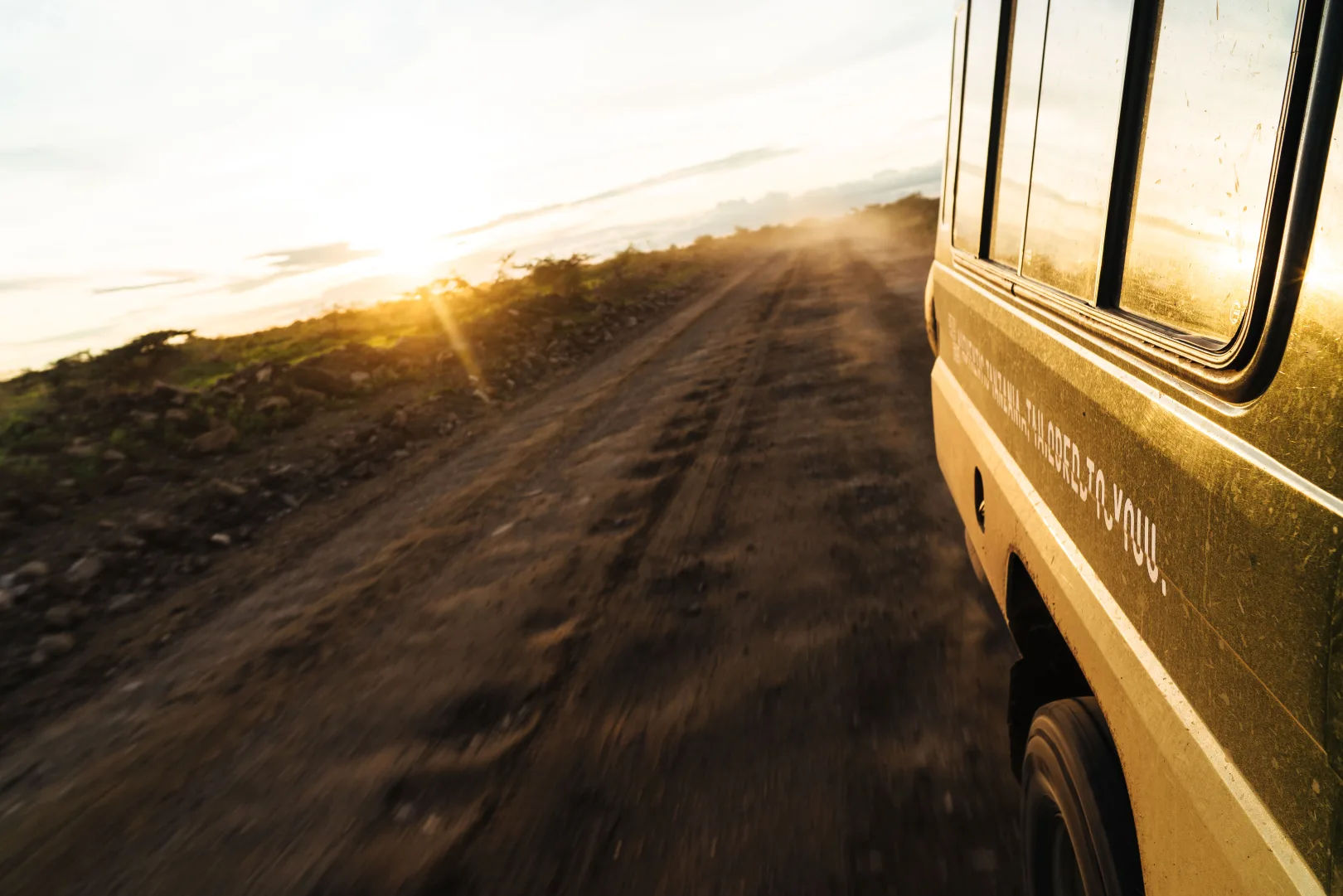
There is a particular kind of traveller who returns to Tanzania. They have done the northern circuit. They have watched the Migration from a crowded viewing point, photographed lionesses on the plains, slept in memorable camps. They are not looking for a repeat. They are looking for what the guidebooks cannot describe.
This is the second safari — and it is not a continuation of the first. It is a different relationship with the country entirely.

Private concession access — what the second safari makes possible
What Changes the Second Time
The logistics of a return visit are unrecognisable from the first. Packing is lighter, briefings are shorter, the acclimatisation curve is already behind you. But the deeper shift is in what you are looking for.
First safaris are about collecting animals. Second safaris are about reading ecosystems — understanding why the cheetah chose that termite mound, why the elephant corridor runs where it does, what the rainfall patterns mean for the next six weeks. The animals are still there, but you are now paying attention to something else.
This is the inflection point where a traveller stops being a tourist and becomes a student of the landscape.
“The first safari shows you what Tanzania is. The second shows you what you are looking for.”
The Concession Difference — and Why It Matters More Now
On a first safari, the national park system is entirely appropriate. The circuit works. The wildlife is extraordinary. The infrastructure is known.
On a second safari, the calculus changes. Private conservancies — the Lamai Triangle, the Grumeti reserves, the Mara North Conservancy — offer something the national parks structurally cannot: lower vehicle density, off-road driving permission, night drives, and walking safaris. These are not add-on luxuries. They are the baseline experience repeat clients are actually paying for.
The difference in vehicle pressure is not cosmetic. At peak season in the Serengeti, a prime viewing point can hold twelve vehicles simultaneously. In a private concession, that same sighting might have one.
Tanzania's Untold Parks
The repeat client gravitates toward what the brochures do not feature.
Ruaha National Park receives roughly 80% fewer visitors annually than the Serengeti. It covers 23,000 square kilometres of miombo woodland, wild dog populations, and landscape diversity that the northern circuit cannot match. The fly-camping options are more developed here than anywhere else in the country. See also: Tanzania parks nobody talks about
Nyerere National Park — formerly the southern sector of the Selous — is Africa's largest national park and one of its least visited. The Rufiji River system creates a landscape of islands, lagoons, and forested banks that is structurally different from anything the northern circuit offers. Access is by charter or scheduled light aircraft; the logistics are deliberate.
Mahale Mountains and Western Tanzania are the most remote sustained experience in the country. Accessible only by boat from the lake shore, Mahale offers chimpanzee tracking in a setting of almost comic-book beauty — forested slopes falling directly into clear Lake Tanganyika. No road reaches it. That is the point.
Specialist Activities That Require Return Visits
The first safari establishes what is possible. The second safari acts on knowledge of what matters.
Fly-camping — sleeping in mobile tents in remote locations, with the sounds of the bush as your only barrier — is not available to first-timers who have not yet built the logistical trust with an operator. It is one of the most genuinely extraordinary experiences available in East Africa. See also: Fly-camping in the Serengeti
Private archaeological access to Olduvai Gorge is possible with the right operator relationships — not the standard museum visit, but a private guided session with the excavation team, standing in the layers of history.
Helicopter access changes the geometry of the country. Landing on the Nasera Rock outcrop, crossing the Crater floor for a private walking experience, reaching terrain above 4,000 metres on the Kilimanjaro massif — these require charter logistics and operator capability that is not commodity. See also: Southern circuit for UHNW families
The Helicopter Question
The choice between private charter and scheduled Light Aircraft is one of the practical dividing lines for a second safari.
Light Aircraft is appropriate and comfortable for the northern circuit — the distances are manageable, the airstrips are good, the flightseeing is part of the experience.
Private charter becomes relevant when the itinerary extends to Nyerere, Ruaha, or Mahale — where drive times become impractical — or when the client values time over cost to the degree that a four-hour drive becomes a forty-minute flight. For UHNW travellers, this is not a luxury decision. It is an efficiency one.
What the First Safari Taught You
If you have been to Tanzania once, you have a reference point that no amount of reading can replicate. You know what the country asks of you physically, what the pace feels like, what surprised you, what you wanted more of.
Tell us what you noticed. That is the most useful planning information we receive — more useful than a budget, more useful than a dates list.
Because a second safari is not a product. It is a conversation about what you actually want from the experience. We will take it from there.
Related Reading
Frequently Asked Questions
Why do experienced safari travellers return to Tanzania instead of trying a new country?
Tanzania's national parks and private conservancies are sufficiently vast and diverse that a second visit offers an entirely different experience. The same traveller returning a second time will access different regions — Ruaha instead of the Serengeti, Nyerere instead of the Ngorongoro — and different activity types: fly-camping, night drives, private archaeological access. The country does not exhaust itself in one visit.
What is the difference between a first safari and a second safari in Tanzania?
A first safari establishes the landscape: the scale of the Serengeti, the density of wildlife in the Ngorongoro Crater, what a lion hunt actually looks like. A second safari builds on that foundation with deliberate intent — private conservancies where vehicle density is structurally lower, remote parks that receive a fraction of the visitors of the northern circuit, and specialist activities like fly-camping and private charter access that require logistical trust built over a first visit.
What are Tanzania's least-visited parks and why do repeat clients go there?
Ruaha National Park receives approximately 80% fewer visitors annually than the Serengeti. Nyerere National Park — formerly the southern Selous — is Africa's largest national park and one of its least visited. The Mahale Mountains on Lake Tanganyika is accessible only by boat and offers chimpanzee tracking in a setting where no road reaches. These are not remote for difficulty's sake — they offer landscapes and experiences structurally unavailable on the northern circuit.
What specialist activities become available on a return Tanzania safari?
Fly-camping — mobile tented camps in remote locations under canvas — requires the logistical trust that comes from a first successful safari. Private archaeological access to Olduvai Gorge, standing in the excavation layers with the research team, is possible with the right operator relationships. Private helicopter charter changes the geometry of the country: Nasera Rock landings, Crater floor access, glacier approaches on Kilimanjaro. These are not upgrades — they are categorically different experiences that require return-visit logistics.
When should a return safari client use private charter instead of scheduled flights?
Light Aircraft is entirely appropriate for the northern circuit — the distances are manageable and the viewing is part of the experience. Private charter becomes relevant when the itinerary extends to Nyerere, Ruaha, or Mahale — where drive times become impractical — or when the client's time-to-experience ratio favours efficiency over cost. For UHNW travellers, this is typically an efficiency decision rather than a luxury one.