
The geological record offers few examples of a gemstone this rare, this concentrated, and this close to exhaustion. Tanzanite occurs in a single 7-square-kilometre formation in the Merelani Hills of northern Tanzania — one deposit, one country, one geological accident that will not repeat itself. The world's supply of extractable tanzanite will, at current rates, be functionally exhausted within two to three decades. There will be tanzanite in the ground after that, but not in quantities that make collector-grade calibrated acquisition at source viable.
For ultra-high-net-worth individuals who acquire fine art, rare wine, and private equity as a category of tangible asset management, tanzanite represents something different: a single-source gemstone market at the precise moment before it develops the institutional infrastructure — ETFs, regulated exchanges, formalised grading standards — that characterises mature collectible markets. The analogy that gemologists use is precise: tanzanite in 2026 is where Kashmir sapphire was in the 1970s for those who acquired it at source.
“There will be tanzanite in the ground after the deposit depletes. There will not be collector-grade calibrated stones available at source. That window is measured in years, not decades.”

The Merelani Hills tanzanite deposit lies within the Simanjiro district, approximately 20km south of the Ngorongoro crater rim — accessible as a half-day extension from any Ngorongoro or Serengeti itinerary
The Rarity Calculus
The comparison to diamonds is instructive, though imperfect. Diamonds are rare in the sense that extraction is expensive, geographically concentrated, and politically fraught. But diamond reserves are distributed across every inhabited continent, with active mines in Canada, Russia, Botswana, Australia, and South Africa. The diamond market is supported by the Kimberley Process Certification Scheme, the GIA grading infrastructure, a global network of exchanges, and a secondary market with price transparency.
Tanzanite has none of this. It occurs in one place. It is not governed by the Kimberley Process. There is no tanzanite ETF. There is no tanzanite commodity exchange. Grading is done by the Tanzanite Authority (ATA) and by independent GIA-affiliated appraisers, but the standards are less codified than for diamond, and the secondary market is thin. What this means for a collector is both a risk and an opportunity: the price discovery mechanism is less efficient than for mainstream collectibles, which means knowledgeable buyers can find significant value discrepancies between equivalent-grade stones from different dealers.
Geologists estimate that the Merelani deposit will be effectively exhausted within 20–30 years at current extraction rates. As the deposit depletes, the population of collector-grade stones at source will shrink toward zero. The stones that exist will be increasingly held by dealers and collectors who understand what they have. The analogy to Kashmir sapphire is well-founded: the early-adopter window for acquiring at source has a defined closing date.
The UHNWI Collector Proposition
The appeal for a serious collector operates across several dimensions simultaneously. The first is tangible rarity: a 3-carat Tanzanite Blue stone of grade 6/5 is genuinely one of perhaps a few thousand such stones in existence. The second is the origin narrative — tanzanite carries the GPS coordinates of its source in a way that no stock certificate or art provenance document achieves. The third is portability: at 1–5 carats, a collection of calibrated stones fits in a small safe deposit box and travels without special licence in most jurisdictions. The fourth, and for some collectors most important, is the acquisition window.
The investment sweet spot for serious collectors is 1 to 5 carats, calibrated stones with GIA colour grading of vB 1–5 and grade 6/5 — the designation that commands the Tanzanite Blue premium. Stones below 1 carat are commercially common; stones above 5 carats are rare but harder to exit at fair value without a specialist buyer network. As with all single-source coloured gemstones, provenance documentation — ATA certificate, independent appraisal, chain of custody from mine to buyer — matters as much as the stone itself.
Bobby Safaris facilitates acquisitions through vetted Arusha dealers who supply museum-grade material to serious collectors, not tourist-traffic retail operations. The experience is arranged as a private viewing: calibrated options with full documentation, time for independent verification, and no obligation. All logistics — export documentation, secure transport, international courier — are handled by Bobby Safaris' logistics team. There are no commissions or referral arrangements affecting which stones are presented.
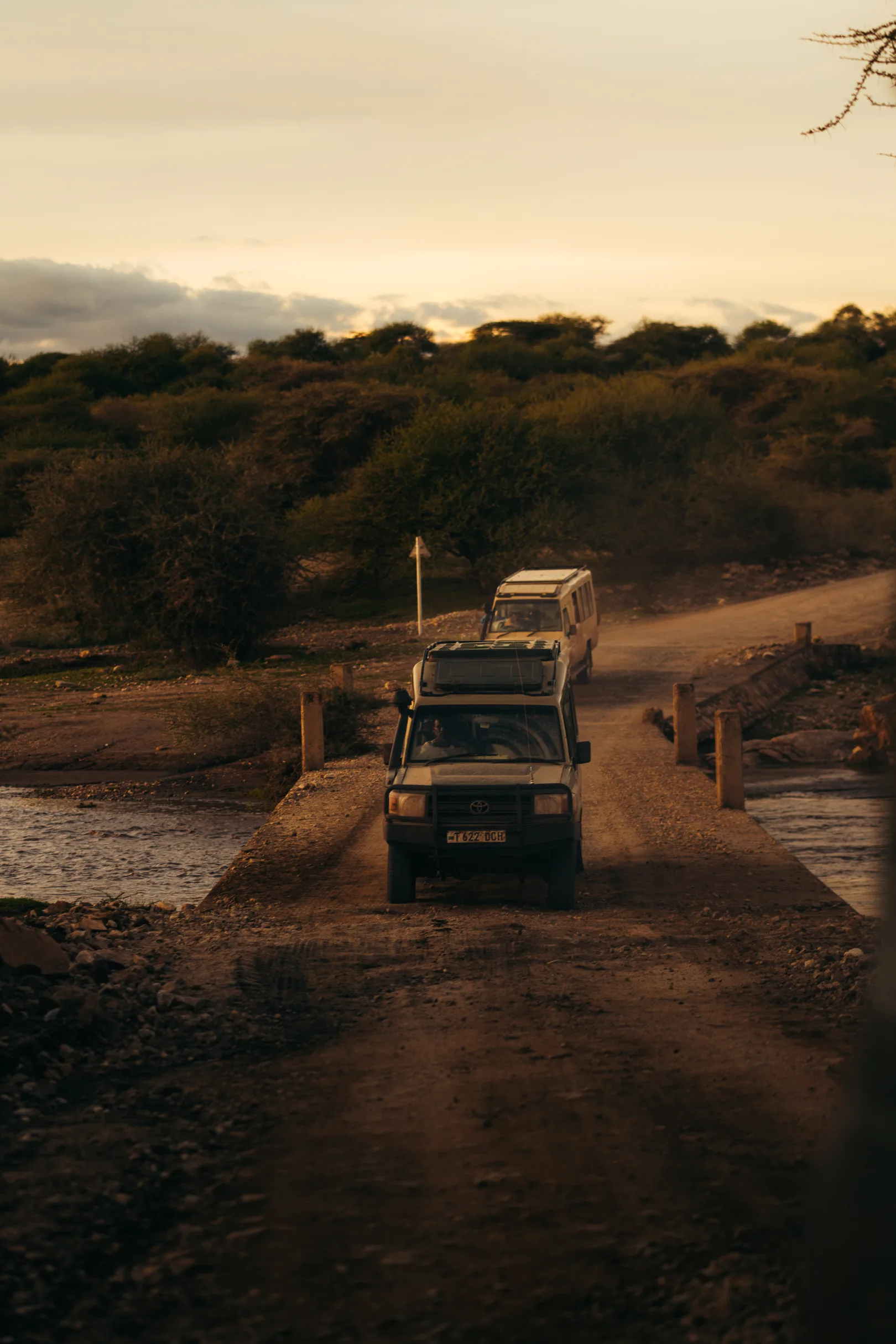
The Ngorongoro crater rim: the tanzanite deposit lies 20km south, making it a natural half-day extension from any Ngorongoro itinerary
Authentication: How to Verify What You Are Buying
Heat treatment is standard for virtually all commercial tanzanite — this is not fraud but disclosure, and a heat-treated stone that is properly described is not worth less than an untreated equivalent. The authentication question is about distinguishing natural tanzanite from glass, synthetic corundum, and other substitutes.
The pleochroism test is the most practically useful field check: rotating a genuine tanzanite under a 10× loupe reveals three distinct colour planes — blue, violet, and burgundy — simultaneously. Glass and synthetic materials do not exhibit this property. Refractive index and specific gravity testing, performed by a certified gemologist in under an hour, provides definitive differentiation from glass and from synthetic tanzanite. Any stone that does not exhibit pleochroism under a loupe should be treated as suspect until tested.
Chain of custody from mine to buyer is the documentation layer that matters most for serious acquisition. ATA certification establishes the stone's identity and grading. An independent GIA-affiliated appraisal — available in Arusha through Bobby Safaris' network — provides a second, independent opinion. The combination of ATA certificate plus independent appraisal, plus a documented chain of custody from the dealer to the buyer, constitutes the minimum acceptable standard for any collector-grade acquisition.
Red flags that should end any transaction: no ATA certificate; pressure to decide within the same visit; no return or buyback policy; resistance to independent verification; stone offered at a price that is meaningfully below market rate for its grade. A reputable dealer integrated into a trusted lodge or itinerary network has no interest in selling misrepresented stones to a buyer who will have the stone independently verified — and the dealers Bobby Safaris works with understand this explicitly.
Itinerary Integration: The Experience, Not the Transaction
A tanzanite viewing arranged through Bobby Safaris is not a tourist excursion to a gift shop. It is a private appointment at a vetted Arusha gallery — or, depending on the itinerary, a presentation at camp from a dealer who brings calibrated options directly — structured to give the collector time to examine, verify, and deliberate without pressure. The half-day experience is designed around the stone and the documentation, not around a commercial environment designed to move inventory.
The natural pairing for tanzanite acquisition is a Ngorongoro Crater itinerary: the Merelani Hills deposit lies approximately 20km south of the crater rim, making it a seamless half-day extension from any Ngorongoro programme. For clients combining a Serengeti migration itinerary with tanzanite acquisition, Bobby Safaris arranges the viewing on the Arusha transit day between the bush and the airport — efficient, low-friction, and separated from the wildlife experience to preserve the distinct register of each.
Export logistics are handled by Bobby Safaris from the moment of acquisition. The ATA certificate travels with the stone; export documentation is prepared by Bobby Safaris' logistics partner in Arusha. International courier is arranged to the client's jurisdiction of residence, with customs declaration support for the destination country. For stones above five carats, clients are advised to confirm their specific country's import declaration requirements before committing to acquisition.
Price range for serious collector acquisition: USD 2,000 to 8,000 per carat for calibrated Tanzanite Blue stones in the 1–5 carat range, depending on grade and certification. Museum-grade stones above 10 carats can reach USD 5,000 to 15,000 per carat at the top end of the market. These figures represent dealer supply pricing at source — not the tourist-facing Arusha street market, which produces different quality material at different price points.

For Serengeti-based clients, tanzanite viewing is arranged on the Arusha transit day — preserving the distinct register of the wildlife experience from the collector environment
The Legacy Dimension
UHNWI families that treat fine gemstone acquisition as a category of relational capital management share a specific insight: the story of a stone is as valuable as the stone itself. A tanzanite acquired at source in Merelani Hills, verified by ATA certification, transported internationally through documented logistics, and gifted as part of a generational transfer carries more relational weight than an equivalent-value wire transfer — and it carries GPS coordinates that no wire transfer can provide.
The generational dimension is not incidental. Families who acquired Kashmir sapphire in the 1970s, Burmese ruby in the 1980s, and Colombian emerald in the 1990s — all before those markets developed institutional infrastructure — understand what the early-adopter window in a single-source gemstone market looks like in retrospect. Tanzanite is at that inflection point now. The deposit is still producing. Collector-grade calibrated stones are still available at source. The institutional infrastructure has not yet arrived. That will change.
Bobby Safaris has been facilitating tanzanite acquisition for clients since the early 2000s. The dealers in the network are people who have been in the tanzanite trade for decades; the relationships are direct and tested. The logistics infrastructure is established. For clients who are collectors first and travellers second, the question is not whether tanzanite is worth acquiring — it is whether this trip to Tanzania is the right moment to do it. For many, it is.
“Tanzanite carries the GPS coordinates of its origin in a way that no stock certificate or art provenance document achieves.”
Arranging a Private Tanzanite Viewing
A tanzanite acquisition experience is arranged in advance as part of itinerary planning — not arranged at the roadside in Arusha. Bobby Safaris will connect you with the vetted dealer network, confirm availability of calibrated stones in your target range, and structure the viewing around your schedule and verification requirements. The experience is available as a half-day extension from any Ngorongoro Crater itinerary, or as a standalone appointment in Arusha for clients transiting between the Serengeti and their international departure.
There is no obligation to purchase. Independent GIA-affiliated appraisal is available on-site or through a separate appointment. All export logistics, documentation, and international courier are handled by Bobby Safaris from the point of acquisition.
Bobby Safaris is a four-generation Arusha family company that has been designing ultra luxury Tanzania safaris since 1978. The Kassim family still operates every detail personally — their own fleet, their own senior guides, their own direct relationships with the exclusive camps and private conservancies their clients visit. For clients who wish to include tanzanite acquisition as part of their Tanzania itinerary, Bobby Safaris has established relationships with vetted Arusha dealers who supply collector-grade stones with full documentation and transparent logistics.