
There are two ways to visit Olduvai Gorge. The first is to stop at the roadside display, read the signage, and move on within twenty minutes as part of a convoy of safari vehicles. The second is to arrive with a specialist paleoanthropologist guide, at a time when the site is clear of other visitors, and spend two to three hours understanding what you are actually looking at — the sediment layers, the fossil beds, the stone tools, and what they collectively tell us about two million years of human evolution in one place.
The first version is the standard version. The second is what Bobby Safaris arranges for travellers who want more.
Olduvai Gorge and the nearby Laetoli footprint site represent the most significant concentration of hominin fossil and artefact evidence on earth. For travellers with a genuine interest in human origins — collectors of natural history, families with children studying archaeology or evolutionary biology, corporate groups who use deep-time context as a framing device — these sites offer an experience with no equivalent anywhere else in the world. But they require advance arrangement to access properly.
"Olduvai Gorge is not a place you visit. It is a place you read — and the reading takes a specialist."

The ancient lakebed sediment at Olduvai Gorge holds evidence of hominin presence spanning approximately two million years
Why Olduvai Gorge Matters to the Right Traveller
Olduvai Gorge entered scientific history in the 1930s when Louis and Mary Leakey began systematic excavation work there, and became globally famous in 1959 when Mary Leakey discovered Zinjanthropus boisei — a nearly complete hominin skull dating to approximately 1.75 million years ago. The subsequent work of the Leakey family and generations of paleoanthropologists has established Olduvai as the single most important site for understanding early human evolution anywhere on earth.
The gorge cuts through approximately 100 metres of sediment layers, each corresponding to a distinct period of human occupation. Stone tools appear in the older layers. Homo habilis remains appear in the middle layers. Homo erectus evidence appears in the newer layers. Standing at the right vantage point, with the right guide, you are effectively looking at two million years of human history organised vertically in the sediment in front of you.
The reason this matters for a luxury traveller — beyond the academic case — is what the site actually offers as an experience. The sensation of standing at a place where something genuinely formative for the human species happened, and understanding what you are looking at, is categorically different from reading about it. It is the difference between a museum visit and the actual site of discovery.
Laetoli, 45 kilometres south of Olduvai, adds the second layer of the experience. The footprints preserved in hardened volcanic ash at Laetoli — discovered in 1976 by a team led by Mary Leakey — are 3.6 million years old and represent the earliest confirmed evidence of bipedal locomotion in early hominins. They are not replicas. They are not casts. They are the actual impressions of two early hominins who walked across wet volcanic ash approximately 3.6 million years ago, before the ash hardened and was buried beneath subsequent sediment layers.
What Private Access Actually Involves
Standard access to Olduvai Gorge means arriving as part of a safari convoy, walking a fixed interpretive path with a park guide, and visiting the small museum display. This is not a poor experience — the site is extraordinary regardless of how you access it — but it is organised around group logistics rather than individual engagement. The guide assigned to a convoy of twenty vehicles is not the same as a specialist in human evolution who is there solely for your party.
Private access requires advance arrangement through the Ngorongoro Conservation Area Authority. Bobby Safaris handles the permit coordination directly. The key elements of a private visit are:
- Exclusive site access — the site is cleared of other visitors during your allocated time. This is not guaranteed; it requires the NCAA to confirm that no other group has been allocated the site during your window.
- Specialist paleoanthropologist guide — not a general park guide but someone with specific expertise in the Olduvai fossil sequence. Bobby Safaris works with researchers and guides who have postgraduate-level familiarity with the site.
- Laetoli permissions — Laetoli requires a separate antiquities permit beyond the standard NCAA conservation area entry. Standard safari itineraries typically do not include Laetoli specifically because the permit process is more involved.
- Transport logistics — the route from a Serengeti camp or Ngorongoro lodge to Olduvai and Laetoli requires planning, particularly for Laetoli which involves off-road driving on conservation area roads.
The combination of these elements transforms what is a roadside stop on most safari itineraries into a genuine experience of the site. The minimum recommended time on site is two hours; three hours is better if your schedule allows.
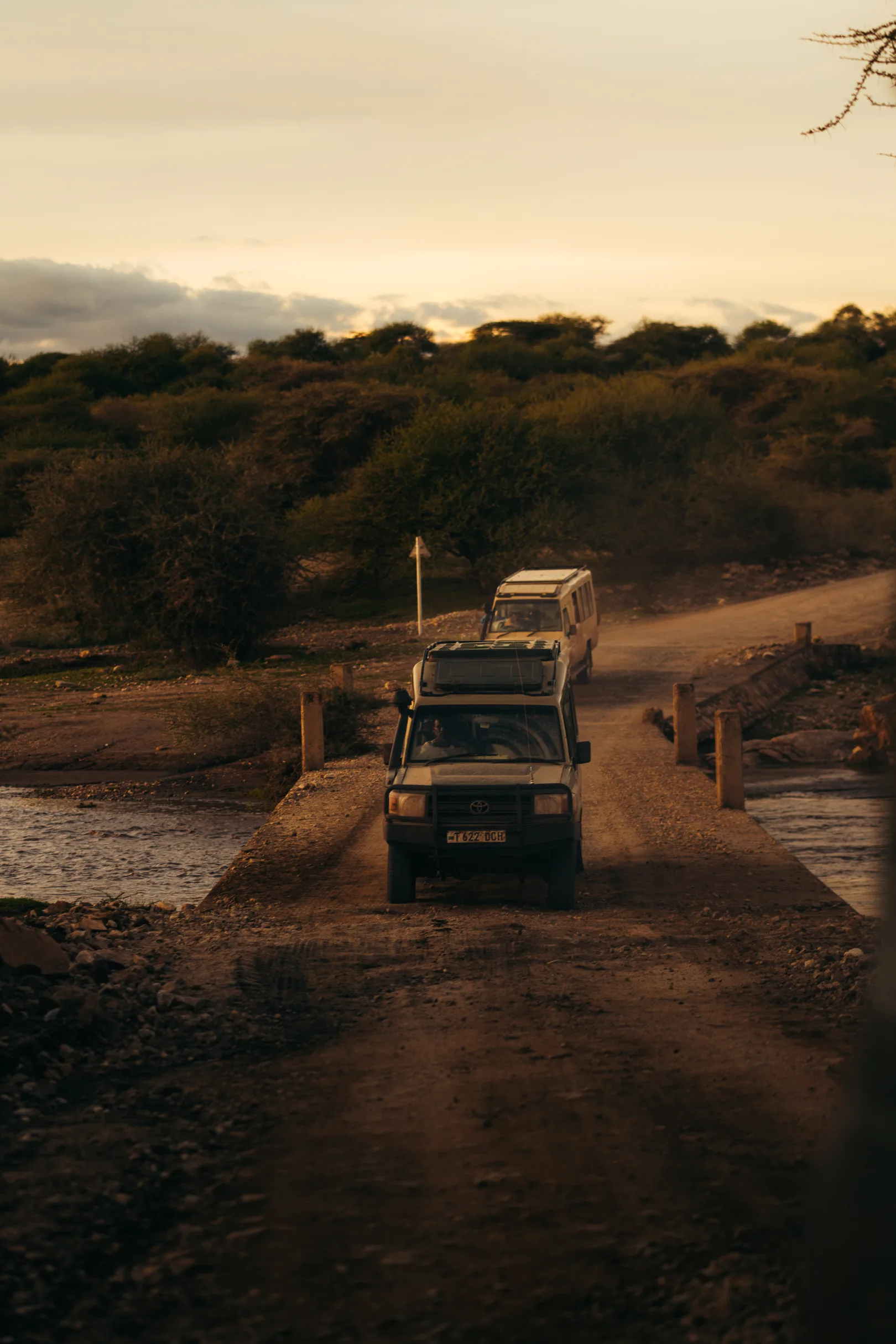
The Ngorongoro highlands overlooking the Olduvai basin — the conservation area that protects both Olduvai Gorge and Laetoli
How It Integrates With a Luxury Safari Itinerary
The most common misconception about a private Olduvai Gorge visit is that it requires a separate trip or significant detour. In practice, the site sits naturally within the northern circuit route — approximately 90 minutes from a central Serengeti camp, and 45 minutes from the Ngorongoro Crater rim.
The recommended approach is to build it as a morning activity on the day you are transiting between Ngorongoro and the Serengeti, or as a standalone half-day from a Serengeti camp. The visit takes two to three hours. You are back at camp or en route to your next destination by mid-morning.
The ideal itinerary placement is between the Ngorongoro Crater descent and your arrival at a Serengeti camp. The Crater floor visit is typically complete by mid-morning; the drive south to the Serengeti's northern reaches passes within easy range of Olduvai. The sequence works logistically without forcing an early start or disrupting the pace of the safari.
Laetoli requires a separate visit — it is in the opposite direction from Olduvai relative to the main safari routes — and is best treated as a dedicated half-day excursion from a Ngorongoro Highlands lodge. If you want both sites, plan accordingly: Olduvai on a transit day, Laetoli as a standalone morning or afternoon from the Crater rim.
Who Should Consider This
Private Olduvai Gorge and Laetoli access is not a default recommendation. The experience rewards a specific kind of traveller. Before suggesting it, Bobby Safaris discusses the intellectual content of the visit with prospective clients to confirm the fit.
Collectors of rare experiences are the most natural fit. UHNWI collectors in natural history, natural science, or anthropology already know why Olduvai matters. For them, the question is not whether to visit but whether to visit properly. Private access answers that question.
Families with academically engaged teenagers often find the experience transforms a safari into something with broader educational resonance. A teenager studying biology, natural sciences, or history who stands at the site where Zinjanthropus boisei was found — with a specialist guide — is having a categorically different experience from their peers who read about it in a textbook. Bobby Safaris has worked with several families where the visit became the defining moment of the trip.
Corporate groups using deep-time context are an emerging use case. Venture capital firms, longevity companies, and frontier science organisations have used the Olduvai and Laetoli visit as a framing device for strategic offsite discussions. The insight that the entire span of human civilisation represents approximately the last 0.5% of the time that early hominins were present in the gorge is a useful reframe for conversations about long-term thinking, patience, and the difference between short-horizon and long-horizon decision-making.
Frequently Asked Questions
What is the difference between Olduvai Gorge and Laetoli?
Olduvai Gorge is a steep ravine in the Serengeti plains where the Leakey family uncovered stone tools and hominin fossils spanning approximately two million years of human evolution. Laetoli is a site roughly 45 kilometres south of Olduvai where 3.6-million-year-old hominin footprints — the oldest confirmed evidence of upright walking by early humans — are preserved in hardened volcanic ash. Both are in the Ngorongoro Conservation Area. A private paleo-tourism itinerary typically visits both, but Laetoli requires special permissions that go beyond standard park access.
How is private access to Olduvai Gorge arranged?
Private access to Olduvai Gorge requires coordinating with the Ngorongoro Conservation Area Authority (NCAA) and, for Laetoli specifically, the antiquities department. Bobby Safaris handles this coordination directly — arranging the relevant permits, the presence of a specialist paleoanthropologist guide, and transport logistics that keep the experience separate from standard group visits. The key distinction is that a private visit to Olduvai Gorge means the site is cleared of other visitors during your time there, and the access route, timing, and guide are arranged specifically for your party.
Who is the ideal traveller for a private Olduvai Gorge and Laetoli visit?
The experience is designed for travellers who have a genuine intellectual interest in human origins and who want more than a roadside stop at a famous fossil site. Collectors — of natural history, art, or experiences of rare access — are a natural fit. Families with teenagers studying archaeology or natural sciences find it transformative. Corporate groups operating in industries adjacent to deep-time thinking — venture capital, frontier science, longevity — often use the experience as a framing device for offsite discussions. The experience is not for everyone; it requires a relevant curiosity and the patience to engage with a site that rewards informed attention.
Can a private Olduvai Gorge visit be combined with a standard luxury safari itinerary?
Yes — and it should be. The northern circuit luxury safari routes naturally pass within range of Olduvai Gorge. The most effective approach is to build the paleoanthropological visit into a multi-day itinerary as a structured morning activity, typically between the Ngorongoro Crater and the Serengeti, or as a standalone half-day departure from a Serengeti camp. It does not require a separate trip. The logistics are handled by your operator; the only variable is whether the access is arranged privately in advance or whether you arrive as part of a standard group visit.
If you are interested in arranging private access to Olduvai Gorge and Laetoli as part of your Tanzania safari, tell us your dates, your group composition, and what is driving the interest in the visit. We will confirm availability, the specific access arrangements, and what the experience involves at your level of detail.