
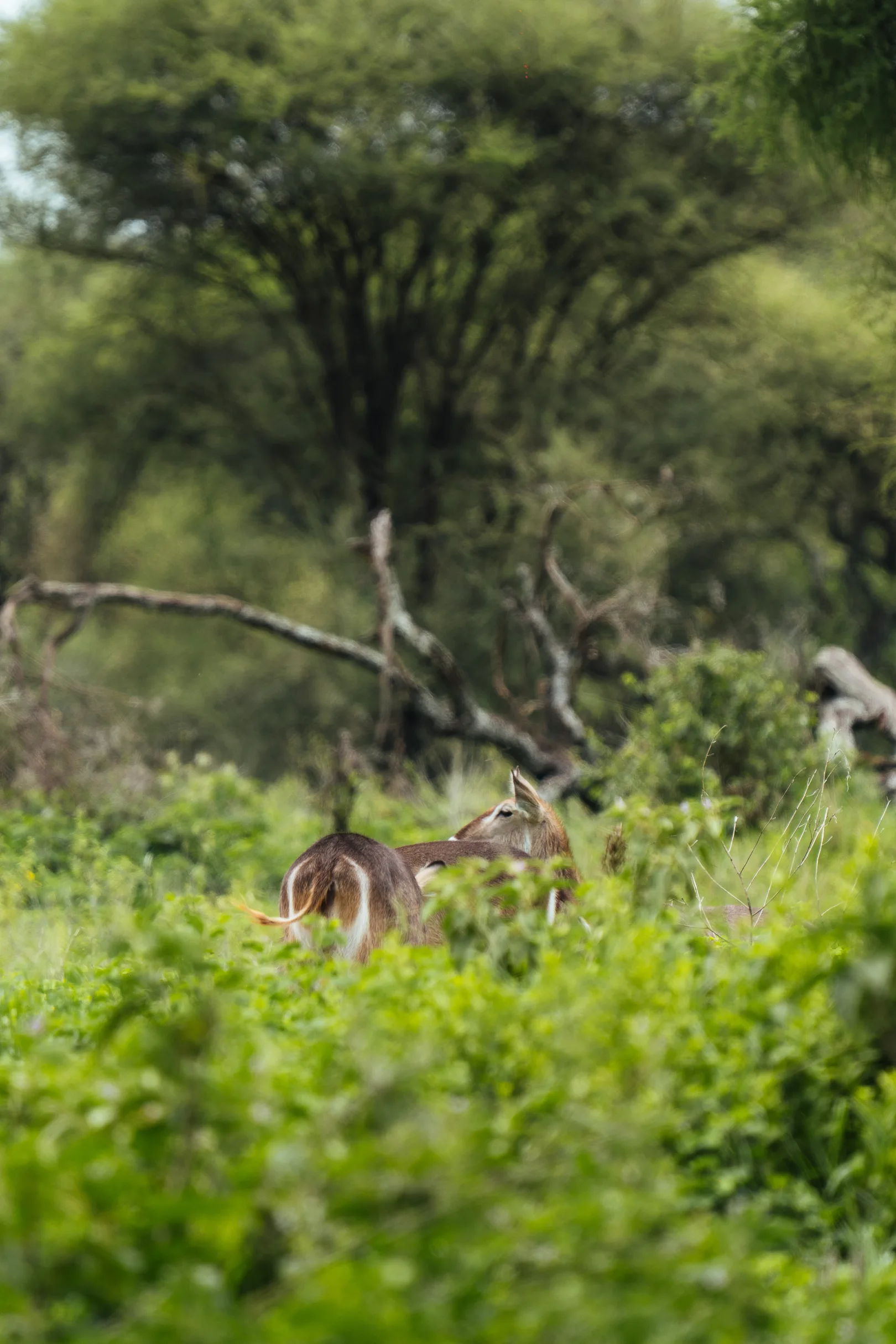
The most prescribed interventions on a UHNW “wellness” safari are spa-rendered: lymphatic-drainage massage, IV drips, infrared saunas. The strongest published evidence base, however, is for the bush itself. A guide-led forest-bathing protocol, calibrated for Tanzanian woodland and routed through the slower half of the itinerary, is the missing ritual in most reset programmes — the canopy immersion that converts a private conservancy camp from lodging into clinical-grade exposure.
The reset safari's missing ritual
A decade of the Bobby Safaris clinical-consultation record — and the emerging literature on longevity tourism in East Africa — points to the same operational gap. Guests arrive with a wellness concept that is, almost without exception, spa-shaped: a treatment room, a therapist, a 60-minute window. The spa pavilion at a private conservancy camp delivers what a spa pavilion delivers, and the operational case for keeping it in the itinerary is straightforward (massage supports sleep architecture; IV drips address the dehydration of long-haul travel; infrared sauna delivers a passive cardiovascular stimulus). The evidence base for the bush as the therapeutic agent — for the canopy, the leaf-litter terpenes, the riverine humidity, the layered soundscape, the multi-night parasympathetic descent — is in a different category entirely. It is the category that does the work.
The gap is not a marketing gap. It is an itinerary-architecture gap. Most “wellness safari” products layer spa treatments on top of a conventional game-drive programme and treat the bush as scenic backdrop. Bobby Safaris has, since the cellular-longevity programme launched, been moving the other direction — treating the bush as the active therapeutic agent and the spa pavilion as adjunct. The forest-bathing protocol formalises that direction for the canopy specifically.
This post is the operational specification for that protocol — what the published literature documents, what Bobby Safaris runs, how it fits alongside game drives, who the programme is designed for, and where its contraindications sit. It is written for guests whose longevity physicians, burnout-recovery teams, or family-office wellness leads are researching whether a safari can deliver a reset beyond the treatment menu.
What shinrin-yoku is — and what the Tanzania version looks like
Shinrin-yoku (森林浴, “forest bathing”) is a Japanese practice formalised by the Japanese Forest Agency in 1982 and now prescribed alongside pharmacotherapy in some Japanese medical systems. The core protocol is two hours of slow, sensory-attentive walking in a forested environment. The most-cited outcomes in the literature include a 12 to 15 percent reduction in salivary cortisol, a 5 to 7 percent reduction in systolic blood pressure, and a measurable increase in natural-killer-cell activity that persists for up to seven days after a single session — the work of Li and colleagues (2007, Environmental Health and Preventive Medicine), Park and colleagues (2010), and the broader review by Kotera, Richardson and Sheffield (2022). The Li study in particular has been reproduced across Japanese, Scandinavian, and North American populations; the cortisol-reduction effect is the most robust single finding in the forest-bathing literature and the one most relevant to the burnout-recovery cluster Bobby Safaris serves.
Three mechanisms are consistently cited in the literature. First, the visual rest of closed canopy: the human eye, adapted over evolutionary time to process complex foliage patterns at close range, is measurably less activated in canopy shade than in open savannah with thermal shimmer. Second, the aromatic load: the volatile organic compounds released by leaf litter and bark — α-pinene, limonene, eugenol, linalool — produce measurable parasympathetic activation when inhaled at the concentrations present in mature woodland. Third, the soundscape transfer: the layered multi-source soundscape of a forest displaces the single-source notifications and ambient mechanical noise that sustain sympathetic activation in urban environments.
The published protocol is forest-type agnostic. The Tanzania version is calibrated for the three woodland types Bobby Safaris operates in:
- Miombo woodland. The Brachystegia / Julbernardia canopy that dominates western Tanzania — the southern reaches of Ruaha, the Mahale fringe, and the drier corridors of Tarangire. Aromatic profile dominated by leaf-litter terpenes (α-pinene, limonene); the ground cover carries wild basil (Ocimum suave) and lemon-grass-family Cymbopogon.
- Riverine forest strips. The narrow gallery forests along the Grumeti and Mara rivers — denser canopy, higher humidity, a broader aromatic palette. Wild fig, wild mango, and Trichilia emit terpenes with documented anxiolytic effects in the phytochemistry literature.
- Lower-slope montane forest.The 1,800 to 2,800 metre band on Kilimanjaro's southern slopes — a third aromatic profile dominated by Ocotea, Podocarpus, and the camphor-rich Trichocladus. Cooler temperatures and higher humidity distinguish the session from low-elevation versions.
The 5-sensory protocol — what Bobby Safaris guides a guest through
Each session is led by a Bobby Safaris guide trained in the 5-sensory protocol. No additional “forest therapy” certification is required — the prerequisite is the existing plant-ID knowledge the guide already carries from the walking-safari and ecological-routes practice. The 5-sensory protocol is the translation of that knowledge into a slower, sensory-attentive format. The session covers:
- See. The canopy gap-and-density variation; light-intensity changes as the eye accommodates to forest shade; the visual rest that the open savannah, with its broad horizons and constant thermal shimmer, does not provide. The guide points out the same canopy gap at the beginning and end of a session so the visual contrast is named. In miombo specifically, the dappled light shift across Brachystegia bark is the strongest visual cue; in riverine forest, the change is in density rather than light.
- Hear. The layered soundscape — overstorey wind, midstorey bird activity, understorey insect and frog chorus — explicitly contrasted with the open-grassland soundscape of game drives. Most guests arrive having spent three or four days listening for animal alarm calls; the forest-bathing session re-trains the ear. The guide may pause at three points during the session to name the most prominent source in each canopy layer, so the soundscape stops being ambient and becomes countable.
- Smell.The dominant aromatic molecules, named as encountered: leaf-litter α-pinene, bark limonene, wild basil eugenol, riverine fig linalool. The guide's role is to make the aromatic vocabulary explicit, not to deliver a chemistry lecture. Most guests report that the named-aroma experience changes their subsequent perception of urban environments — they begin to smell coffee, traffic, and HVAC air in ways they previously could not.
- Touch. Bark texture — rough Brachystegia, smooth Trichilia, papery Podocarpus — and the leaf-warmth differential between sun-side and shade-side foliage. The guide invites a brief pause at one or two key textures; guests who have not consciously touched a tree in years are often surprised at the affective weight of the contact.
- Taste.A curated “taste of the bush” element on guided sessions only, never self-directed: a single wild basil leaf, a single lemon-grass blade, a single wild fig fragment. The guide controls all wild-tasting — guests do not self-sample — and the tasting is omitted entirely if the guide judges the local ecology unsuitable, if guests have declared relevant allergies during pre-departure screening, or if the season has produced uncertain identification. The tasting is mnemonic rather than nutritional: it converts the aromatic vocabulary into a remembered sensory event.
How the programme fits into a 12 to 14 night Bobby Safaris itinerary
Programme structure for a typical 12-night reset itinerary, with forest-bathing scheduled alongside game drives rather than in parallel:
- Days 1 to 3 — arrival, acclimatisation.No forest-bathing sessions. Cortisol and adrenaline remain travel-elevated; the body's read of the forest is contaminated by jet-lag residue, and the session would be processed as a game drive rather than as a sensory immersion.
- Days 4 to 6 — introduction. One 90-minute session in miombo woodland, paired with the morning game drive. The afternoon is reserved for the spa pavilion programme (massage, IV, infrared sauna), which works as a complement to the forest-bathing effect rather than a substitute for it.
- Days 7 to 9 — deepening. Two sessions, in two different forest types (miombo and a riverine strip), with the afternoon freed for the spa pavilion programme. This is the period in which the cumulative cortisol-reduction effect documented in the literature begins to compound.
- Days 10 to 12 — integration. One final session, in the most biodiverse forest type on the itinerary, followed by a guided reflection hour with the guide. The reflection hour is a Bobby Safaris operational element not present in the published shinrin-yoku literature; it converts the sensory experience into a working narrative the guest can carry home.
- Day 13 onward — departure, post-tour.The literature suggests the cortisol-reduction and NK-cell-activity benefits persist seven days after a single session; the programme's effect carries through the journey home and into the first week of return-to-work. Bobby Safaris sends a post-itinerary note summarising the forest sites visited and the aromatic molecules encountered, for clients who wish to extend the practice in a domestic setting.
Who the programme is for — and who it is not for
The forest-bathing programme is designed for the burnout-recovery, longevity, and executive-stress cluster Bobby Safaris already serves. It is not designed for the photo-led safari guest — the slow sensory walking conflicts directly with the early-morning golden-light photographic priorities — or for the high-mileage guest moving camps every two nights. The published cortisol-reduction effect requires three or more consecutive nights at a single site; a camp-every-two-nights itinerary cannot deliver it. This is worth stating clearly so inquiry-stage guests do not book a high-mileage itinerary expecting the programme.
Guests whose interest is the cellular-level counterpart — biomarker measurement, BDNF, IL-6 — should read the cellular longevity protocols page in parallel; the forest-bathing programme and the biomarker programme can be combined, but the test panel and the protocol structure differ. For guests whose interest is the executive burnout-recovery persona specifically, the executive-safari burnout-recovery framing is the closer match.
Safety and contraindication notes
Walking-safari level fitness is sufficient. The terrain is uneven (leaf-litter, root, occasional slope) but involves no climbing. No wildlife risk is present in any of the three named forest types — Bobby Safaris does not offer the programme in any high-density wildlife area, and the canopy and humidity in the named sites keep large-mammal traffic low. Insect-bite prevention (DEET, permethrin-treated clothing, long sleeves at dawn and dusk) is built into the kit at each camp. Guests with severe tree-pollen allergies, bee-venom allergies, or who are pregnant in the first trimester are screened pre-departure; the programme can be modified, replaced with a canopy-walk substitute, or omitted on medical advice without compromising the rest of the itinerary.
The science-backing — what Bobby Safaris publishes, and what it does not
The forest-bathing programme is published under a “guide-led, evidence-informed” framing. It is not a clinical therapy, and it is not marketed as one. The published outcomes — cortisol reduction, NK-cell increase, blood-pressure reduction — are reported as observed in the literature (Li et al., 2007; Park et al., 2010; Kotera et al., 2022), not as guaranteed outcomes for individual guests. No claim is made that forest bathing cures or treats any medical condition. The guide's plant-ID and aromatic vocabulary remain the operational backbone; the literature is the framing, not the guarantee.
Three framing decisions follow from that posture. First, the programme is never published as a substitute for prescribed pharmacotherapy or physician-supervised care; the consultation process explicitly defers to the treating physician on medication interactions and contraindications. Second, the published outcomes are framed as population-level findings from the literature, not as guest-specific outcomes Bobby Safaris warrants or predicts; individual response will vary by baseline cortisol, prior exposure to nature-immersion protocols, and the degree to which the itinerary delivers the multi-night, multi-forest-type structure the evidence base assumes. Third, the operational claim is that Bobby Safaris runs the protocol faithfully to the published structure — slow, sensory-attentive, in mature woodland, for the prescribed duration — so that the conditions under which the published outcomes were observed are the conditions under which the guest experiences the programme.
Guests working with a treating physician who would like to compare pre-trip and post-trip biomarkers — fasting cortisol curve, hs-CRP, IL-6, overnight HRV — can do so via the same consultation process described on the cellular longevity protocols page. The five-marker panel is the same in both contexts; the forest-bathing programme adds one further dimension that does not appear in standard bloodwork: the olfactory and tactile stimulus documented in the literature as a parasympathetic-shift trigger. Where the cellular-longevity programme is measured at the biomarker level, the forest-bathing programme is measured at the biomarker level and at the subjective-experience level (the guided reflection hour produces a written record the guest can take into the next physician consultation).
Adjacent practices that pair well with forest bathing
Three Bobby Safaris itinerary elements compose naturally with the forest-bathing programme. The awe-walk practice is a related but distinct sensory-walking protocol — slower than a game drive, more verbal than a forest-bathing session, oriented around visual scale rather than aromatic immersion. The two can be scheduled on alternating days for guests whose physicians are prescribing a multi-modal nature-immersion protocol. The forest-bathing session restores the olfactory and parasympathetic channels; the awe-walk practice restores the visual-scale channel. Combined across a 12 to 14 night itinerary, the two protocols address three of the five senses that the urban environment starves — and they do so without competing with the game-drive programme, which carries the visual-predator channel that no wellness protocol can substitute for.
The walking-safari practice is the most commonly confused companion. A walking safari focuses on tracking, animal sign, and big-game awareness in open terrain; a forest-bathing session focuses on sensory immersion in closed canopy. Many guests do both during the same itinerary. The 14-night chronobiology reset is the longer-form schedule counterpart: it embeds the forest-bathing programme inside a full circadian-alignment itinerary, with the bush's photoperiod doing the work of the master clock across the full two-week window.
The destinations that host the programme — the miombo of Tarangire, the riverine corridors of the Serengeti and the migration corridor, and the lower slopes of Kilimanjaro — are unchanged from the existing Bobby Safaris itinerary architecture. The programme is an added layer, not a substituted path. The umbrella framing — and the broader evidence base for the bush as a therapeutic agent — is set out on the regenerative safari science page.
Designing a reset itinerary around forest bathing
Bobby Safaris works with longevity physicians, burnout-recovery teams, and family-office wellness leads to structure itineraries that combine the forest-bathing programme with biomarker measurement, the chronobiology reset, or the spa-pavilion programme. If you are advising a client on the operational specification, we can facilitate the consultation directly.
Begin the wellness consultationFurther reading on the Bobby Safaris wellness-longevity cluster: regenerative safari science · cellular longevity protocols · the chronobiology of the bush · the awe walk · walking safaris.